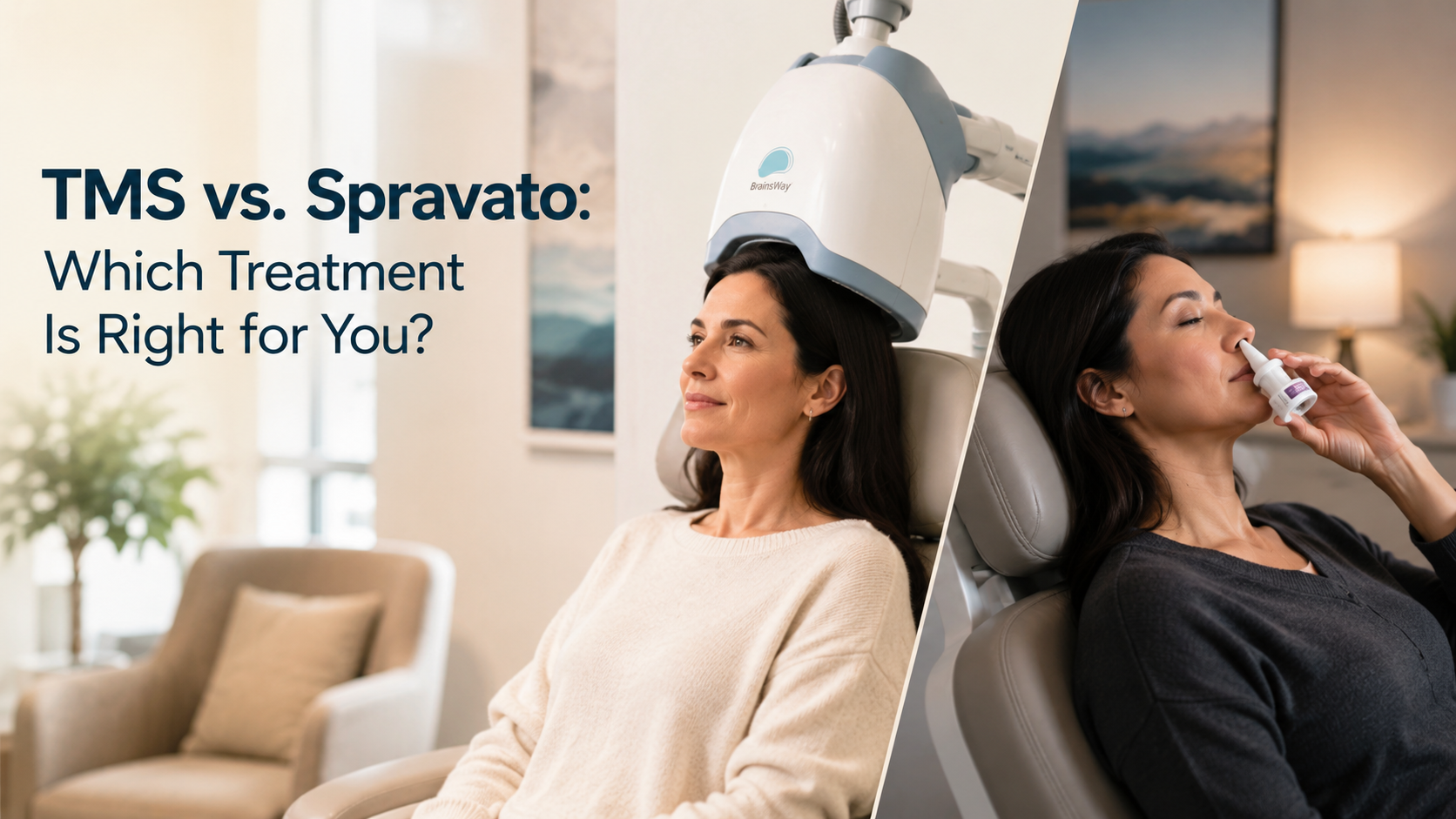

If two or more antidepressants haven’t lifted your depression, you’ve likely landed on two names that keep coming up: TMS and Spravato. Both are FDA-approved for treatment-resistant depression, both work when standard medications have failed, and both are available here in Maryland. But they are very different treatments. The short version: TMS uses magnetic pulses to stimulate the brain — no drug, no sedation, and benefits that tend to last. Spravato is a fast-acting esketamine nasal spray given under supervision in the office, with relief that can arrive in hours but usually needs ongoing maintenance.
This guide breaks down how each one works, how fast it works, side effects, cost, who qualifies, and how a psychiatrist actually chooses between them — so you can walk into your consultation already knowing the right questions to ask.
TMS vs. Spravato at a Glance
Feature
TMS (Transcranial Magnetic Stimulation)
Spravato (Esketamine)
What it is
Non-invasive magnetic brain stimulation — no medication
Esketamine nasal spray (a prescription medication)
How it works
Magnetic pulses stimulate mood-regulating regions (prefrontal cortex)
Acts on the brain’s glutamate/NMDA system to rapidly restore connections
Speed of relief
Gradual — usually 2 to 6 weeks
Rapid — often within hours to the first week
Schedule
5 days/week for ~6 weeks (30–36 sessions), ~20 min each
Twice weekly, then weekly, then every 1–2 weeks; ~2 hours per visit
In-office monitoring
None — you drive yourself home and resume your day
Required — 2-hour observation; no driving until the next day
Common side effects
Scalp discomfort, mild headache
Dissociation, dizziness, nausea, short-term blood-pressure rise
Durability
Often lasts many months to a year after the course
Usually requires ongoing maintenance dosing
Insurance
Covered by most major plans + Medicare/Medicaid for MDD
Covered by most major plans + Medicare/Medicaid for TRD
Both are strong options. The “best” choice depends on how quickly you need relief, your tolerance for the time commitment, your medical history, and whether you’d rather avoid a medication altogether. Below, we unpack each.
What Is TMS (Transcranial Magnetic Stimulation)?
TMS is a non-invasive, drug-free treatment that uses targeted magnetic pulses — the same type used in an MRI — to stimulate the areas of the brain involved in mood regulation. It was first FDA-cleared for major depressive disorder in 2008, and is now also cleared for OCD, anxious depression, and smoking cessation. At Bright Horizons Psychiatry, we use BrainsWay Deep TMS, which reaches deeper, broader brain regions than older “figure-8” coils.
How TMS Works
A cushioned coil rests against your scalp and delivers brief magnetic pulses to the left dorsolateral prefrontal cortex — a region that is typically underactive in depression. Over a course of treatment, this repeated stimulation strengthens the brain circuits that regulate mood, essentially helping an under-firing network “wake back up.” Because nothing enters your bloodstream, TMS has no systemic drug effects, no sedation, and no risk of dependence.
The TMS Treatment Schedule
A standard course is 5 sessions per week for about 6 weeks (30–36 sessions total), followed by a brief taper. Each Deep TMS session lasts roughly 20 minutes. If the daily commitment feels daunting, ask about accelerated TMS, which compresses treatment into 1–2 weeks using multiple short sessions per day.
What a TMS Session Feels Like
You sit in a reclining chair, fully awake. You’ll feel a tapping sensation on your scalp and hear a clicking sound during each pulse. Some people notice mild scalp tenderness or a light headache in the first week, which usually fades as you get used to it. When the session ends, you drive yourself home or back to work — there are no restrictions. For a full breakdown, see our guide to TMS side effects and what to expect.
What Is Spravato (Esketamine)?
Spravato is the brand name for esketamine, a nasal-spray medication derived from ketamine. The FDA first approved it in 2019 for treatment-resistant depression (used alongside an oral antidepressant) and in 2020 for major depressive disorder with acute suicidal thoughts. In January 2025, the FDA approved Spravato as a standalone monotherapy for TRD — the first medication of its kind cleared to work on its own. Because it can only be given in a certified clinic, Bright Horizons Psychiatry is a REMS-certified Spravato provider.
How Spravato Works
Unlike traditional antidepressants that adjust serotonin over weeks, esketamine acts on the brain’s glutamate system by blocking NMDA receptors. This triggers a rapid increase in synaptic connections — which is why some patients feel a shift in days rather than months. It’s a fundamentally different mechanism, which is exactly why it can help when SSRIs and SNRIs haven’t. (For how it differs from pills, see Spravato vs. traditional antidepressants.)
The Spravato Treatment Schedule
The induction phase is twice weekly for the first 4 weeks, then once weekly for weeks 5–8, then tapering to once every 1–2 weeks for maintenance. You self-administer the spray in the office under supervision. Each visit takes about two hours because of the required monitoring period. Curious about the timeline of results? See how long Spravato takes to work.
What a Spravato Session Feels Like
After taking the spray, you’ll rest in a quiet, comfortable room while a clinician monitors you for about two hours. Many patients experience a temporary floaty, dreamlike feeling (dissociation), mild dizziness, or nausea, which typically resolves before you leave. Because of these effects, you cannot drive for the rest of the day — you’ll need a ride home. More detail in our guide to Spravato side effects.
Effectiveness: How Well Does Each Work?
Both treatments have solid evidence behind them, but they perform differently.
TMS. Real-world studies consistently show that roughly 50–60% of people with treatment-resistant depression respond to standard TMS, and about one-third reach full remission. Newer accelerated protocols push those numbers higher: in Stanford’s SAINT/SNT research published in the American Journal of Psychiatry, about 79% of participants reached remission in a double-blind trial (and roughly 90% in the earlier open-label study) after just five days of intensive treatment. See our deeper dive on the TMS success rate.
Spravato. Esketamine’s signature strength is speed and rescue power. Clinical trials (the TRANSFORM program) and the head-to-head ESCAPE-TRD study found esketamine produced higher response and remission rates than placebo and than extended-release quetiapine, with improvement sometimes visible within 24 hours. The trade-off: benefits tend to fade if treatment stops, which is why maintenance dosing matters. See our breakdown of the Spravato success rate.
Speed vs. Durability: The Core Trade-Off
If you remember one thing, make it this: Spravato is built for speed; TMS is built for durability.
Spravato can pull someone out of a deep, even dangerous depressive episode quickly — which makes it valuable when symptoms are severe or when waiting weeks isn’t safe. But the relief generally depends on continued dosing. TMS works more gradually over several weeks, yet once you complete the course, the benefits often hold for many months to a year, frequently without any ongoing maintenance. Many people choose based on this single question: Do I need relief fast, or do I want the longest-lasting result with no medication?
Side Effects and Safety Compared
TMS Side Effects
TMS is very well tolerated. The most common effects are mild scalp discomfort and headache during the first week. There’s no sedation, no weight gain, no sexual side effects, and no cognitive fog. The main serious risk — seizure — is extremely rare (well under 0.1%). TMS is not suitable for people with non-removable ferromagnetic metal in or near the head (such as aneurysm clips or certain implants).
Spravato Side Effects
Spravato’s side effects are more systemic and are why in-office monitoring is mandatory: dissociation, dizziness, nausea, sedation, and a temporary rise in blood pressure. It carries an FDA Boxed Warning for sedation, dissociation, and the potential for misuse, and it must be administered through the REMS safety program. It’s generally avoided in people with certain cardiovascular or aneurysmal conditions. We outline all of this on our Important Safety Information page.
Cost and Insurance: TMS vs. Spravato
Here’s the good news most articles bury: both treatments are covered by most major insurance plans — including CareFirst BCBS, Aetna, Cigna, UnitedHealthcare, TRICARE, Johns Hopkins EHP, Medicare, and Maryland Medicaid — when you meet medical-necessity criteria (typically a diagnosis plus two or more failed antidepressants).
For TMS, most insured patients pay between $0 and $50 per session, which works out to roughly $600–$1,800 for a full course. Without insurance, a standard course runs about $6,000–$12,000. Full numbers are in our TMS cost in Maryland breakdown and our does insurance cover TMS guide.
For Spravato, coverage is broad but the medication itself is expensive, so your out-of-pocket depends heavily on your plan and any manufacturer savings programs. We walk through the real numbers in how much Spravato costs and is Spravato covered by insurance in Maryland. Our team handles prior authorizations in-house for both treatments.
Who Is a Candidate for Each?
TMS may be the better fit if you: want to avoid medication and side effects, prefer a treatment you can fit around work (no sedation, drive yourself), are looking for durable, long-lasting relief, or have not tolerated antidepressants well. It’s not an option if you have ferromagnetic metal implants near the head or a seizure history that your psychiatrist deems high-risk.
Spravato may be the better fit if you: need rapid relief, have severe symptoms or significant suicidal thinking, have a reliable ride to and from appointments, and don’t have contraindicating cardiovascular conditions. It pairs well with patients who want a fast response while other parts of their treatment plan take effect.
Not sure whether your depression even qualifies as treatment-resistant? Start with how to know if you have treatment-resistant depression.
Can You Combine TMS and Spravato?
Yes — and in some cases that combination is the most effective path. Because TMS and Spravato work through completely different mechanisms (magnetic stimulation vs. glutamate modulation), they can complement each other. A common strategy is to use Spravato for rapid early relief while a course of TMS builds more durable, longer-lasting improvement underneath it. Whether combining makes sense for you is a clinical decision your psychiatrist makes based on your history, severity, and response — it isn’t a DIY choice, but it is very much on the table.
Where Does Ketamine Fit In?
Spravato (esketamine) is a refined, FDA-approved cousin of ketamine, delivered as a nasal spray in a certified clinic. Generic ketamine can also be given by IV or intramuscular injection, which is typically faster-acting and lower-cost per dose but not FDA-approved specifically for depression (it’s used off-label). We offer intramuscular ketamine as well, and compare all three formats in Spravato vs. IV ketamine vs. IM ketamine. If you’re also weighing older procedures, see TMS vs. ECT.
Which Treatment Is Right for You?
There’s no universally “better” option — there’s a better option for you. Use this quick framework:
- Choose TMS if you want a drug-free, side-effect-light treatment with durable results and you can commit to daily sessions for a few weeks.
- Choose Spravato if you need relief quickly, your symptoms are severe, and you can arrange transportation for in-office visits.
- Consider both if you need fast relief now and a foundation that lasts.
The honest truth is that this decision is best made with a psychiatrist who can review your full treatment history. The same medication failures that frustrate you are exactly the clues that point toward the right next step.
TMS and Spravato in Rockville & Frederick, Maryland
Bright Horizons Psychiatry is a specialty practice focused on treatment-resistant depression, led by board-certified psychiatrist Dr. Amir Etesam. We offer both TMS and Spravato under one roof — along with IM ketamine and medication management — so your treatment plan is matched to your needs, not to whatever a single-service clinic happens to offer. We serve patients across Rockville, Bethesda, and Montgomery County from our primary office, with a second location in Frederick, MD.
If you’ve tried two or more antidepressants without real relief, you have more options than you’ve been told. Book a consultation and we’ll help you figure out whether TMS, Spravato, or a combination is the right fit — and handle the insurance paperwork for you.
Frequently Asked Questions
Is Spravato or TMS better?
Neither is universally better — they suit different needs. TMS tends to win for durable, medication-free, long-term relief; Spravato wins for speed and for severe episodes that need rapid intervention. Studies suggest TMS may have a higher long-term success rate, while Spravato acts faster. A psychiatrist matches the treatment to your history and goals.
Which works faster, TMS or Spravato?
Spravato is much faster. Many patients feel improvement within hours to the first week, whereas TMS typically takes 2 to 6 weeks to show meaningful benefit. The trade-off is that TMS results tend to last longer once the course is complete.
Can you do TMS and Spravato at the same time?
Yes. Because they work through different mechanisms, they can be combined — often using Spravato for rapid early relief while TMS builds longer-lasting improvement. This is a clinical decision made with your psychiatrist based on your specific situation.
Is TMS or Spravato covered by insurance?
Both are covered by most major insurers and by Medicare and Maryland Medicaid when you meet medical-necessity criteria (usually a diagnosis plus two or more failed antidepressants). We handle prior authorizations in-house for both.
What are the main side effects of each?
TMS: mild scalp discomfort and headache, with no sedation or systemic effects. Spravato: dissociation, dizziness, nausea, and a temporary blood-pressure rise, which is why two hours of in-office monitoring and no same-day driving are required.
Is Spravato the same as ketamine?
Not exactly. Spravato is esketamine — a purified component of ketamine — delivered as an FDA-approved nasal spray under medical supervision. Generic ketamine (given by IV or injection) is related but used off-label for depression.
Clinical Sources
- FDA / Johnson & Johnson — Spravato approved as first monotherapy for treatment-resistant depression (Jan 2025)
- Cole et al., American Journal of Psychiatry — Stanford Neuromodulation Therapy (SAINT): double-blind randomized controlled trial
- Cole et al., American Journal of Psychiatry — Stanford Accelerated Intelligent Neuromodulation Therapy for TRD
- American Journal of Psychiatry — Esketamine for Depression: PRISMA systematic review and meta-analysis
- ESCAPE-TRD study — Esketamine nasal spray vs. quetiapine XR over 32 weeks in TRD