
If you have been researching TMS therapy for depression, OCD, or another condition, you have probably noticed that the marketing from different clinics looks roughly the same on the surface. Most clinics emphasize “FDA-approved,” “non-invasive,” and “drug-free” without explaining what device they actually use or how it differs from the device down the street.
The two most common TMS devices in the United States are NeuroStar (made by Neuronetics) and BrainsWay (made by an Israeli company of the same name). They look similar in marketing photos. They are clinically distinct in important ways. Standard NeuroStar TMS and BrainsWay Deep TMS are not just different brand names for the same thing. They use different coil shapes, reach different depths in the brain, treat different sets of FDA-cleared conditions, and have different treatment protocols.
This guide explains how NeuroStar and BrainsWay Deep TMS actually differ, what those differences mean clinically, and how to decide which one is a better fit for which patients. By the end you should be able to ask a TMS clinic the right questions before you commit to a treatment course.
Standard TMS and Deep TMS Are Not the Same Technology
Both NeuroStar and BrainsWay Deep TMS are transcranial magnetic stimulation devices. They both use focused magnetic pulses to activate specific regions of the brain. They are both FDA-cleared. They are both non-invasive and do not require anesthesia. From a patient’s chair, both look like a session of sitting still while a coil pulses against the head.
The differences are in the engineering and the clinical reach.
NeuroStar Uses a Figure-8 Coil
NeuroStar TMS is the original FDA-cleared TMS device for depression, approved in 2008. It uses a figure-8 coil, which is the standard TMS coil shape. The coil is positioned over the dorsolateral prefrontal cortex, the brain region most associated with mood regulation in depression. Magnetic pulses penetrate approximately two centimeters below the surface of the skull, stimulating the targeted cortical area.
NeuroStar TMS is FDA-cleared for major depressive disorder, anxious depression (depression with co-occurring anxiety symptoms), OCD, and major depressive disorder in adolescents ages 15 and up. Standard treatment protocol is roughly 19 to 37 minutes per session, five days a week, for six weeks.
BrainsWay Uses an H-Coil for Deep TMS
BrainsWay’s signature device uses a patented H-coil design integrated into a cushioned helmet rather than a positioned arm. The H-coil shape allows magnetic pulses to penetrate roughly six centimeters below the skull surface, reaching deeper and broader brain structures than a standard figure-8 coil can. This is what “Deep TMS” actually refers to. The depth and breadth of stimulation, not just a marketing label.
BrainsWay Deep TMS is FDA-cleared for major depressive disorder, OCD, and short-term smoking cessation. Treatment sessions are shorter than NeuroStar (typically 20 minutes), but the total course of treatment is similar in length.
Why the Coil Difference Matters Clinically
The depth and breadth of brain stimulation is not just a technical detail. It changes which patients are likely to respond and what conditions the device can effectively treat.
Depth of Penetration
Major depression and many other psychiatric conditions involve circuits that connect surface cortical regions with deeper structures of the brain. A figure-8 coil that reaches two centimeters can effectively stimulate the cortical end of these circuits. An H-coil that reaches six centimeters can stimulate both the cortical region and some of the deeper connecting structures.
For straightforward major depression that responds to standard treatment, both devices produce meaningful improvement in clinical trials. For treatment-resistant depression, where the depression has not responded to multiple antidepressants and standard outpatient treatment, the deeper and broader stimulation pattern of BrainsWay may have an advantage in some patients. The clinical evidence on this is still evolving, and not every TRD patient needs Deep TMS specifically. Some respond well to NeuroStar.
Breadth of Stimulation
The H-coil also stimulates a broader area than a figure-8 coil. The trade-off is that figure-8 coils have more focal precision (stimulating a smaller, more targeted area), while H-coils have less precision but reach more brain tissue at once. Each design has clinical applications where it shines.
For OCD, where the relevant circuits involve the medial prefrontal cortex and anterior cingulate cortex (deeper structures), Deep TMS has FDA clearance and is the more commonly prescribed device. For depression, both have FDA clearance and the choice depends on patient factors.
FDA-Cleared Indications
The list of FDA-cleared indications differs between the two devices, and this matters for insurance coverage as much as for clinical decision-making.
NeuroStar is FDA-cleared for major depressive disorder, anxious depression, OCD, and adolescent depression. BrainsWay Deep TMS is FDA-cleared for major depressive disorder, OCD, and smoking cessation. Both have OCD clearance, but the clearances came in different years and through different clinical trial pathways. Insurance coverage tends to follow FDA clearance closely, so the device available at a given clinic affects which conditions can be treated under insurance at that location.
What Patients Actually Experience With Each Device
The patient experience differs in some practical ways even though both devices use the same general mechanism of action.
The Treatment Setup
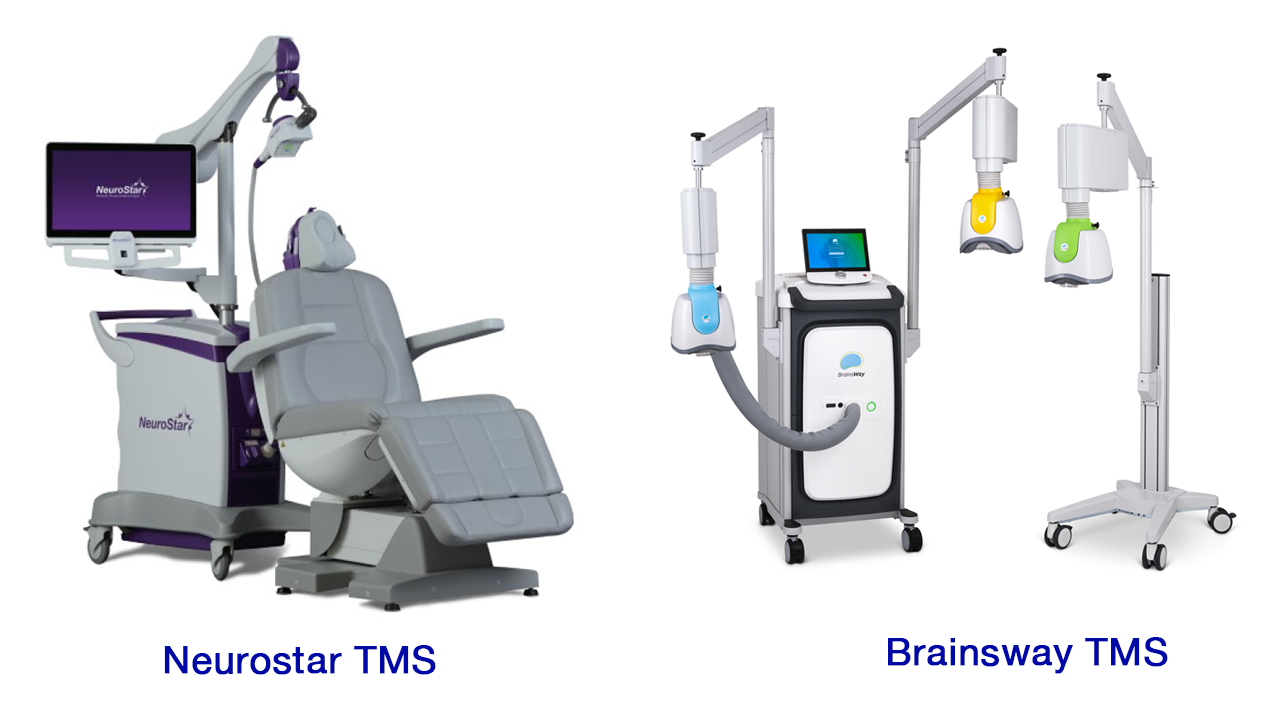
NeuroStar treatment typically involves a chair with a positioning arm that holds the figure-8 coil against the patient’s head at a precisely calibrated angle. The coil position has to be set up at the start of each session, and the patient stays still during treatment to maintain the position.
BrainsWay Deep TMS uses a helmet that the patient wears throughout the session. The helmet is cushioned and the H-coil is integrated inside it. This setup allows slightly more head movement during treatment without compromising stimulation accuracy, which some patients find more comfortable.
Session Length
BrainsWay Deep TMS sessions are usually 20 minutes. NeuroStar sessions historically ran 37 minutes for the standard protocol, although newer NeuroStar protocols have shortened to under 20 minutes in some cases. The shorter session length of Deep TMS adds up across a six-week treatment course, which matters for patients fitting treatment around work schedules.
Sensation During Treatment
Both devices produce a tapping or knocking sensation on the scalp during pulses. Some patients describe NeuroStar’s tapping as more intense or louder. Others describe BrainsWay’s helmet as feeling more enclosed. Most patients adapt to either device within a few sessions, and scalp discomfort usually fades after the first week of treatment regardless of which device is used.
Side Effects
Side effects are similar between the two devices. The most common is mild scalp discomfort during the session, which improves over time. Headache after treatment is also common in the first week. Neither device produces the systemic side effects associated with antidepressant medications (no weight gain, no sexual side effects, no sedation, no cognitive fog).
The risk of seizure exists with any TMS device but is rare, occurring in fewer than one in tens of thousands of treatments when proper screening protocols are followed.
How to Tell Which Device a Clinic Uses
Most clinic websites do not prominently say which device they use, partly because patients rarely ask and partly because it is easier to market “TMS therapy” generally. A few quick checks help clarify which device a clinic actually has.
Ask directly during the consultation call. The intake team should be able to tell you whether the clinic uses NeuroStar, BrainsWay Deep TMS, or another device. If they cannot answer, that is a small red flag.
Check the FDA-cleared indications they advertise. A clinic offering “TMS for OCD” with FDA clearance is most often using BrainsWay or a NeuroStar configuration that has the OCD clearance. A clinic offering “TMS for adolescent depression” is most likely using NeuroStar, since adolescent MDD clearance is currently a NeuroStar indication.
Look at the photos of the treatment room. A NeuroStar setup typically shows a chair with a positioning arm and a figure-8 coil. A BrainsWay Deep TMS setup typically shows a chair with a helmet that the patient wears.
Read the clinical descriptions on the treatment page. Clinics that specifically use the term “Deep TMS” with capitalization and explicit reference to the H-coil are usually BrainsWay. Clinics that say “TMS therapy” without specifying depth are more often standard TMS.
Which Device Is Right for Which Patients
For patients trying to choose between TMS clinics, the device choice can shape the decision in some situations and barely matter in others.
Where the Device Choice Matters Most
For OCD treatment, BrainsWay Deep TMS has been the more established option clinically since its 2018 FDA clearance for OCD, and many clinics that specialize in OCD have chosen Deep TMS for that reason.
For treatment-resistant depression where multiple medication trials and possibly standard TMS have not worked, the deeper stimulation of BrainsWay may offer additional benefit, although evidence varies and a thorough psychiatric evaluation is the right way to make this call.
For adolescent depression, NeuroStar is currently the device with FDA clearance for ages 15 and up, so families seeking TMS for an adolescent are more likely to find NeuroStar at the clinics they evaluate.
Where the Device Choice Matters Less
For straightforward major depressive disorder in adults, both devices produce similar response rates in clinical trials. The clinic’s experience, the prescribing psychiatrist’s expertise, and the overall quality of care often matter more than which specific device is used.
For anxious depression, both have applicability and the difference between devices is less clinically meaningful than the differences between clinics.
Other Factors That Often Matter More
The single most important factor in TMS treatment success is not the device. It is whether the prescribing psychiatrist takes the time to do a proper evaluation, to make sure TMS is the right treatment for the situation, and to monitor treatment carefully. A NeuroStar device in the hands of a thoughtful psychiatrist usually outperforms a BrainsWay device in a high-volume corporate TMS network where treatment is delivered without much customization.
The other practical factors that matter to patients are the clinic’s accessibility, the staff experience, the comfort of the treatment environment, the support during the first weeks when scalp discomfort is most pronounced, and how well the clinic coordinates with the patient’s other providers.
TMS Treatment at Bright Horizons Psychiatry
Our practice in Rockville offers BrainsWay Deep TMS as our primary TMS modality. The choice was clinical, not commercial. The patient population we treat skews toward treatment-resistant depression, complex mood disorders, and OCD, where the deeper and broader stimulation profile of the H-coil aligns with the conditions most of our TMS patients are dealing with.
What Our TMS Program Looks Like
Treatment is led by Dr. Amir Etesam, a Johns Hopkins-affiliated psychiatrist, in a boutique outpatient setting rather than a high-volume corporate TMS network. Each patient is evaluated individually before TMS is recommended, and treatment is customized rather than delivered as a one-size-fits-all protocol.
Sessions run about 20 minutes. The treatment course follows the standard protocol of five sessions per week for six to eight weeks, with maintenance options available for patients who benefit and want to continue. Full details on our TMS program are available on our TMS therapy page.
Conditions We Treat With TMS
Our TMS program is most often used for major depressive disorder, treatment-resistant depression, OCD, and anxious depression. We also treat selected cases of anxiety and PTSD with TMS, recognizing that some of these uses are off-label and require a careful clinical conversation about the evidence and expected outcomes.
Insurance Coverage
TMS is covered by Medicare, Maryland Medicaid, and most major commercial insurance plans for FDA-cleared indications, particularly major depressive disorder. Our intake team handles prior authorizations and coverage verification before treatment begins, so patients have a clear understanding of out-of-pocket costs before starting.
Questions Worth Asking Before Starting TMS Anywhere
If you are evaluating TMS clinics, several questions help clarify whether the practice does the work properly regardless of which device they use.
Ask which TMS device the clinic uses and why they chose it. A clinic that has thought carefully about device selection should be able to answer.
Ask who performs the initial evaluation and whether TMS is recommended only after a thorough evaluation, not as the first option for every patient who walks in.
Ask about response rates and remission rates for the conditions you are being treated for, and whether the clinic tracks these for their own patients.
Ask about the protocol for managing the first week of treatment, when scalp discomfort and headaches are most common.
Ask whether the clinic coordinates with your other psychiatric providers and what the plan is if TMS does not produce the expected response.
Ask about insurance coverage, prior authorization handling, and what happens if insurance denies coverage partway through the treatment course.
For more on TMS as a treatment modality and FDA-cleared device specifications, the FDA’s overview of TMS devices is the authoritative reference.
Frequently Asked Questions
Is BrainsWay Deep TMS better than NeuroStar?
Not categorically. The deeper and broader stimulation of BrainsWay’s H-coil has clinical advantages for some patients, particularly those with treatment-resistant depression or OCD. For straightforward major depression, both devices produce similar response rates in clinical trials. The right device depends on the diagnosis, prior treatment history, and individual factors that should be discussed during the psychiatric evaluation.
Why do some clinics use NeuroStar and others use BrainsWay?
Clinics choose devices based on cost, available FDA clearances, patient population, and clinical philosophy. NeuroStar has the largest installed base in the United States and the longest track record. BrainsWay is the only Deep TMS device on the market and is favored by clinics that prioritize the deeper stimulation pattern, particularly for OCD and treatment-resistant depression. Some clinics have both devices.
Does insurance cover both NeuroStar and BrainsWay Deep TMS?
Most commercial insurance plans, Medicare, and Maryland Medicaid cover TMS for FDA-cleared indications regardless of which device is used. Coverage criteria typically include a documented diagnosis of major depressive disorder and at least two failed antidepressant trials. Prior authorization is almost always required.
How do I know which device my insurance will cover?
Coverage is generally based on the FDA-cleared indication being treated, not the specific device brand. If you have major depressive disorder and meet the failed-medication criteria, both NeuroStar and BrainsWay Deep TMS are typically covered. The clinic’s intake team usually handles verification before treatment begins.
Are the side effects different between NeuroStar and BrainsWay?
The side effect profiles are similar. Both produce mild scalp discomfort during sessions, occasional headache, and rare risk of seizure. Some patients find one device’s tapping sensation more comfortable than the other, but this is individual rather than systematic.
Can I switch from NeuroStar to BrainsWay Deep TMS partway through treatment?
Switching mid-course is possible but not common. If a patient is not responding to one device after a meaningful trial (typically four to six weeks), the psychiatrist may discuss alternative protocols or different devices. More often, patients who do not respond to one TMS course try a different treatment approach entirely (medication adjustment, Spravato, or other options) rather than switching devices.
How long does TMS treatment take regardless of which device is used?
Standard TMS treatment is five sessions per week for six to eight weeks, totaling roughly 30 to 40 sessions. Each session is 20 to 37 minutes depending on the device and protocol. Maintenance treatment, when continued after the initial course, is typically once weekly or as needed based on response.