
If you’ve been researching TMS therapy, you’ve probably seen the scary numbers: $6,000, $10,000, even $15,000. Here’s the part most of those articles bury — the vast majority of patients in Maryland never pay anything close to that. With insurance, most of our patients pay between $0 and $50 per session, which works out to roughly $600 to $1,800 for an entire course of treatment. Without insurance, a full course runs about $6,000 to $12,000.
The gap between those two numbers is the whole story of TMS pricing — and it’s why a “full course costs $10,000” headline is so misleading. This guide breaks down exactly what TMS therapy costs in Maryland in 2026: the price per session, the cost by protocol type, what you’ll pay with versus without insurance, and the factors that move the number up or down. Where insurance gets complicated, we’ll point you to our dedicated Maryland TMS insurance guide.
How Much Does TMS Therapy Cost in Maryland? (Quick Answer)
A standard course of TMS is 30–36 sessions over about 6–8 weeks (five sessions per week). What that costs you depends almost entirely on whether you use insurance:
Your situation
What you’ll pay
With insurance (most Maryland patients)
$0–$50 per session → roughly $600–$1,800 for the full course
Without insurance (standard or Deep TMS, cash pay)
$6,000–$12,000 for the full course
Accelerated TMS (self-pay, rarely covered)
$3,000–$5,000
SAINT TMS (self-pay, premium protocol)
$30,000+
The single biggest lever is insurance. Because TMS is FDA-approved and covered by nearly every major Maryland plan — including Medicare and Maryland Medicaid — most people who qualify pay a per-session copay rather than the full sticker price. The rest of this guide explains how those numbers are built, so you can estimate your own cost with confidence.
TMS Cost by Protocol Type
“TMS” isn’t one single treatment. There are several protocols, and the one you receive is the biggest factor behind the cash price. Here’s how they compare in 2026.
Standard rTMS — $6,000–$12,000
Repetitive TMS (rTMS) is the original protocol, FDA-approved for depression since 2008. It has the longest track record and the most reliable insurance coverage of any form of TMS. A standard course is 5 sessions per week for 4–6 weeks, with each session lasting 30–45 minutes. Because the clinical evidence is so well established, this is the protocol insurers approve most readily.
Deep TMS (BrainsWay) — $6,000–$12,000
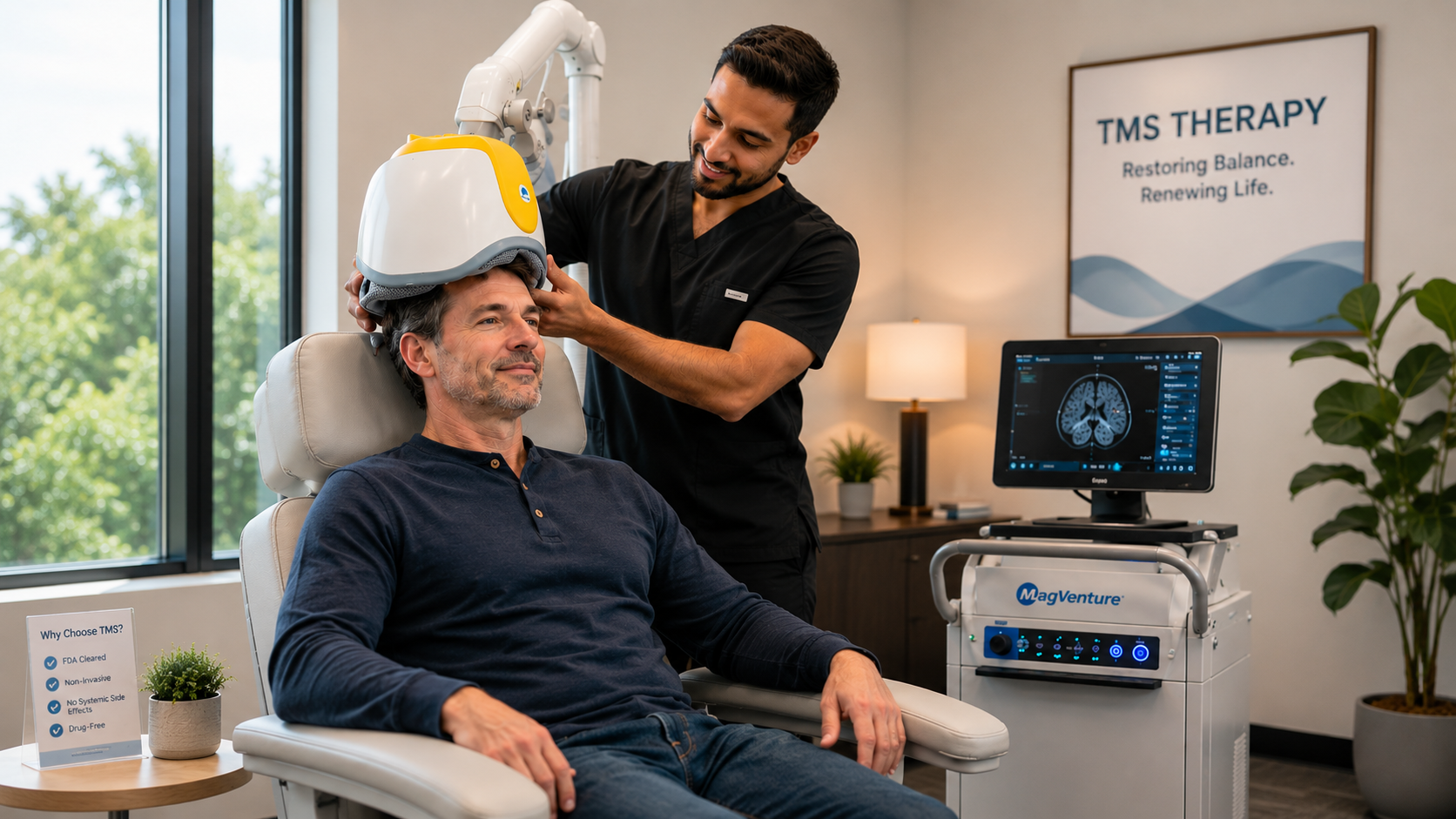
Deep TMS uses an “H-coil” to reach broader, deeper brain regions than standard rTMS. It was FDA-approved in 2013 and is what we use at Bright Horizons Psychiatry. Sessions are shorter — about 19 minutes versus 30–45 for standard rTMS — and it’s particularly useful for medication-resistant depression and co-occurring conditions like anxious depression. Importantly, Deep TMS costs the same as standard rTMS and is covered by the same insurance plans once prior authorization is approved. You are not penalized on price for choosing the more advanced coil.
Accelerated TMS / iTBS — $3,000–$5,000 (usually self-pay)
Accelerated TMS compresses the standard 6-week course into 1–2 weeks by delivering multiple short sessions per day using intermittent theta-burst stimulation (iTBS). The appeal is speed — relief in days rather than weeks. The catch is that most insurers don’t cover it yet because the evidence base is newer, so patients typically pay $3,000–$5,000 out of pocket. As clinical data accumulates, we expect coverage to expand.
SAINT TMS — $30,000+ (self-pay)
SAINT (Stanford Accelerated Intelligent Neuromodulation Therapy) layers fMRI brain imaging and neuronavigation onto accelerated iTBS to target each patient’s brain with extreme precision. Early results are impressive, but it requires proprietary equipment and licensing, which pushes the price to $30,000 and up. It’s rarely covered by commercial insurance, though Medicare has begun setting hospital reimbursement rates, a sign that broader coverage may follow.
Protocol
Sessions / timeline
Typical cash cost
Insurance coverage
Standard rTMS
30–36 over 4–6 weeks
$6,000–$12,000
Widely covered
Deep TMS (BrainsWay)
30–36 over 4–6 weeks
$6,000–$12,000
Widely covered
Accelerated TMS (iTBS)
Multiple/day over 1–2 weeks
$3,000–$5,000
Rarely covered
SAINT TMS
~50 over 5 days
$30,000+
Rarely covered
The takeaway: if you’re using insurance, the covered protocols (standard rTMS and Deep TMS) are also the most affordable, because your cost is a copay rather than the full price. The premium self-pay protocols buy you speed or precision, not better insurance economics.
TMS Cost With Insurance in Maryland
This is where the real number lives for most people. TMS is covered for major depressive disorder by virtually every major insurer operating in Maryland, and once you’re approved, you pay a per-session copay — not the full course price.
For most of our patients, that means $0–$50 per session, or about $600–$1,800 for the entire course. Here’s how it breaks down by payer.
Commercial Plans (CareFirst BCBS, Aetna, Cigna, UnitedHealthcare)
Maryland’s commercial market is dominated by CareFirst BlueCross BlueShield, and like Aetna, Cigna, and UnitedHealthcare, it covers TMS for depression once prior-authorization criteria are met. Your exact cost depends on your plan’s copay and deductible structure — some plans cover 80% after deductible, others 90%. In practice, most commercial patients land in the $20–$50 per session range, which is the $600–$1,800 total above. We verify your specific benefits before your first session so there are no surprises.
Medicare
Medicare covers TMS for major depressive disorder when clinical criteria are met. After your annual deductible, you pay the standard 20% coinsurance — typically around $35–$50 per session for a standard course.
Maryland Medicaid
Medicaid coverage for TMS has expanded significantly, and Bright Horizons Psychiatry accepts Maryland Medicaid. Out-of-pocket cost is minimal — usually $0–$5 per session depending on your specific Medicaid plan.
What Insurance Requires Before It Pays
Insurers don’t approve TMS automatically. Nearly all require prior authorization showing the treatment is medically necessary. The common criteria across Maryland plans:
Requirement
What it means
Confirmed MDD diagnosis
A documented major depressive disorder diagnosis (not general low mood)
Failed medication trials
Usually 2–4 antidepressants tried at therapeutic doses without adequate relief
Ongoing therapy/care
Evidence you’ve engaged in psychotherapy or psychiatric treatment
No contraindications
No certain metallic implants near the head or uncontrolled seizure disorder
Approval typically takes 5–10 business days. For a full walkthrough of coverage, denials, and appeals, see our complete Maryland TMS insurance guide — at Bright Horizons, our staff handles the entire authorization process for you.
TMS Cost Without Insurance (Cash Pay)
If you don’t have coverage — or your plan denies TMS — a full cash-pay course of standard or Deep TMS in Maryland runs about $6,000–$12,000. That reflects roughly $300–$500 per session across a 30–45 session course, which is in line with national averages.
People end up paying cash for a few reasons: a high-deductible plan that hasn’t been met, an insurer that won’t authorize treatment, a desire for a non-covered protocol like accelerated or SAINT TMS, or treatment for a condition other than depression (insurers generally cover TMS only for MDD, even though it’s used off-label for other conditions).
If you’re facing cash pay, don’t assume the sticker price is final. Most clinics — including ours — will first try to get you covered through insurance verification and appeals, and offer financing or payment plans when coverage truly isn’t available. More on that below.
What Affects the Cost of TMS in Maryland
Even within Maryland, two patients can pay very different amounts. The main factors:
- Insurance status. By far the biggest driver. The same course can cost $600 with insurance or $12,000 without.
- Protocol. Standard rTMS and Deep TMS sit at the affordable end; accelerated and SAINT cost more and are usually self-pay.
- Number of sessions. A standard course is 30–36 sessions, but some patients need maintenance or booster sessions later, which add to the total.
- Facility type. Hospitals and academic medical centers tend to charge the most. Dedicated outpatient psychiatry practices are typically more competitively priced.
- Location within Maryland. Clinics in higher-cost areas like the D.C. suburbs (Bethesda, Rockville, Chevy Chase) may price differently than rural practices, though insurance copays even out much of that difference.
- Consultation and mapping fees. Some clinics charge separately for the initial evaluation and the first “brain mapping” session ($100–$300); others fold it into the course. Always ask what’s included.
How to Make TMS More Affordable
If cost is the barrier, there are several legitimate ways to bring it down:
- Use your insurance — and appeal if denied. This is the single most effective step. A denial is not the end; with proper documentation, most appeals succeed. Our team manages appeals at no extra cost.
- Pay with an HSA or FSA. TMS is a qualified medical expense. Paying with pre-tax dollars from a Health Savings Account or Flexible Spending Account effectively saves you 20–30% depending on your tax bracket.
- Ask about financing and payment plans. Many clinics offer monthly payment plans or medical financing (such as CareCredit) so you can spread the cost rather than pay upfront.
- Choose a covered protocol. If budget is tight, standard rTMS or Deep TMS — both insurance-covered — will almost always cost far less out of pocket than a self-pay accelerated or SAINT course.
- Verify benefits before you start. Knowing your deductible status and copay up front prevents surprise bills. We offer a free insurance verification before your first visit.
Is TMS Therapy Worth the Cost?
For many patients with treatment-resistant depression, yes — and the math is more favorable than the headline price suggests.
Clinically, standard TMS produces roughly a 50% response rate and about 30% full remission in patients who haven’t responded to medication. Deep TMS and the newer accelerated protocols report higher figures still, with the Stanford SAINT protocol showing remission rates near 79% in early trials. Results typically last 6 to 12 months, and many patients sustain improvement well beyond that; if symptoms return, a shorter maintenance course usually re-establishes the benefit.
Weighed against the alternative — years of medication trials, ongoing copays, side effects, and the real cost of depression on work and relationships — a one-time course that many patients complete for a few hundred dollars (with insurance) is, for the right candidate, one of the better values in psychiatric care. It’s also drug-free, non-invasive, and carries no systemic side effects like weight gain or sexual dysfunction. For a side-by-side with other options, see our comparison of TMS vs. ECT.
That said, TMS doesn’t work for everyone — roughly 30–50% of patients don’t respond significantly — and it requires a meaningful time commitment of near-daily visits for several weeks. Whether it’s worth it depends on your specific clinical situation, which is exactly what a consultation is for.
TMS Therapy Cost at Bright Horizons Psychiatry (Rockville & Frederick)
At Bright Horizons Psychiatry, we keep TMS pricing simple and transparent:
- With insurance: $0–$50 per session — about $600–$1,800 for a full course. We’re in-network with all major Maryland insurers, including CareFirst BCBS, Aetna, Cigna, UnitedHealthcare, TRICARE, Johns Hopkins EHP, Medicare, and Maryland Medicaid.
- Without insurance: $6,000–$12,000 for a full course of Deep TMS.
We use BrainsWay Deep TMS, and our staff handles the entire insurance verification and prior-authorization process for you — including appeals if needed. Before you commit to anything, we verify your exact benefits at no charge, so you know your real out-of-pocket cost in advance.
Care is led by Dr. Amir Etesam, MD, a board-certified, Johns Hopkins–trained psychiatrist whose practice focuses specifically on treatment-resistant depression. We see patients at our Rockville office (6000 Executive Blvd, Suite 101) and, opening August 2026, in Frederick — serving Montgomery County and the greater Washington, D.C. area.
Want to know what TMS will actually cost you? Book a free consultation or call (240) 599-1001. We’ll verify your coverage and give you an honest answer — no pressure, no obligation.
Frequently Asked Questions
How much does TMS cost per session?
Without insurance, TMS runs about $300–$500 per session. With insurance, you pay only a copay — typically $0–$50 per session in Maryland — because your plan covers the bulk of the cost.
How much does TMS cost without insurance?
A full cash-pay course of standard or Deep TMS costs about $6,000–$12,000. Accelerated TMS is roughly $3,000–$5,000, and SAINT TMS can exceed $30,000.
Does insurance cover TMS in Maryland?
Yes. Nearly all major Maryland insurers — CareFirst BCBS, Aetna, Cigna, UnitedHealthcare, TRICARE, Medicare, and Maryland Medicaid — cover TMS for major depressive disorder once prior-authorization criteria are met. See our Maryland TMS insurance guide for full details.
What disqualifies you for TMS?
The main contraindications are certain non-removable metallic or electronic implants in or near the head (such as aneurysm clips, cochlear implants, or stents — dental fillings are fine) and an uncontrolled seizure disorder. For insurance coverage specifically, you typically also need a documented MDD diagnosis and a history of failed medication trials.
How many TMS sessions will I need?
A standard course is 30–36 sessions over 6–8 weeks, five days a week. Accelerated protocols compress this into 1–2 weeks. Some patients later benefit from occasional maintenance sessions.
Does TMS cost more than Spravato or ketamine?
It depends on your coverage and protocol. Like TMS, Spravato (esketamine) is covered by most insurers for treatment-resistant depression, while IM ketamine is generally self-pay. The best-value option for you depends on your diagnosis, insurance, and treatment goals — something we sort out during your consultation.
Will my Maryland insurance require me to fail medications first?
Usually, yes. Most plans require documentation that you’ve tried 2–4 antidepressants at therapeutic doses without adequate relief before they’ll authorize TMS for treatment-resistant depression. Our staff documents this for you as part of the prior-authorization process.
This article is for educational purposes and is not a substitute for individualized medical advice. Costs are 2026 estimates and vary by plan, protocol, and provider. Verify your specific benefits before beginning treatment.
Sources: FDA TMS clearances (rTMS 2008, BrainsWay Deep TMS 2013); Centers for Medicare & Medicaid Services TMS coverage determinations; Cole et al., “Stanford Accelerated Intelligent Neuromodulation Therapy (SAINT),” American Journal of Psychiatry, 2021; Bright Horizons Psychiatry published TMS pricing and insurance data.