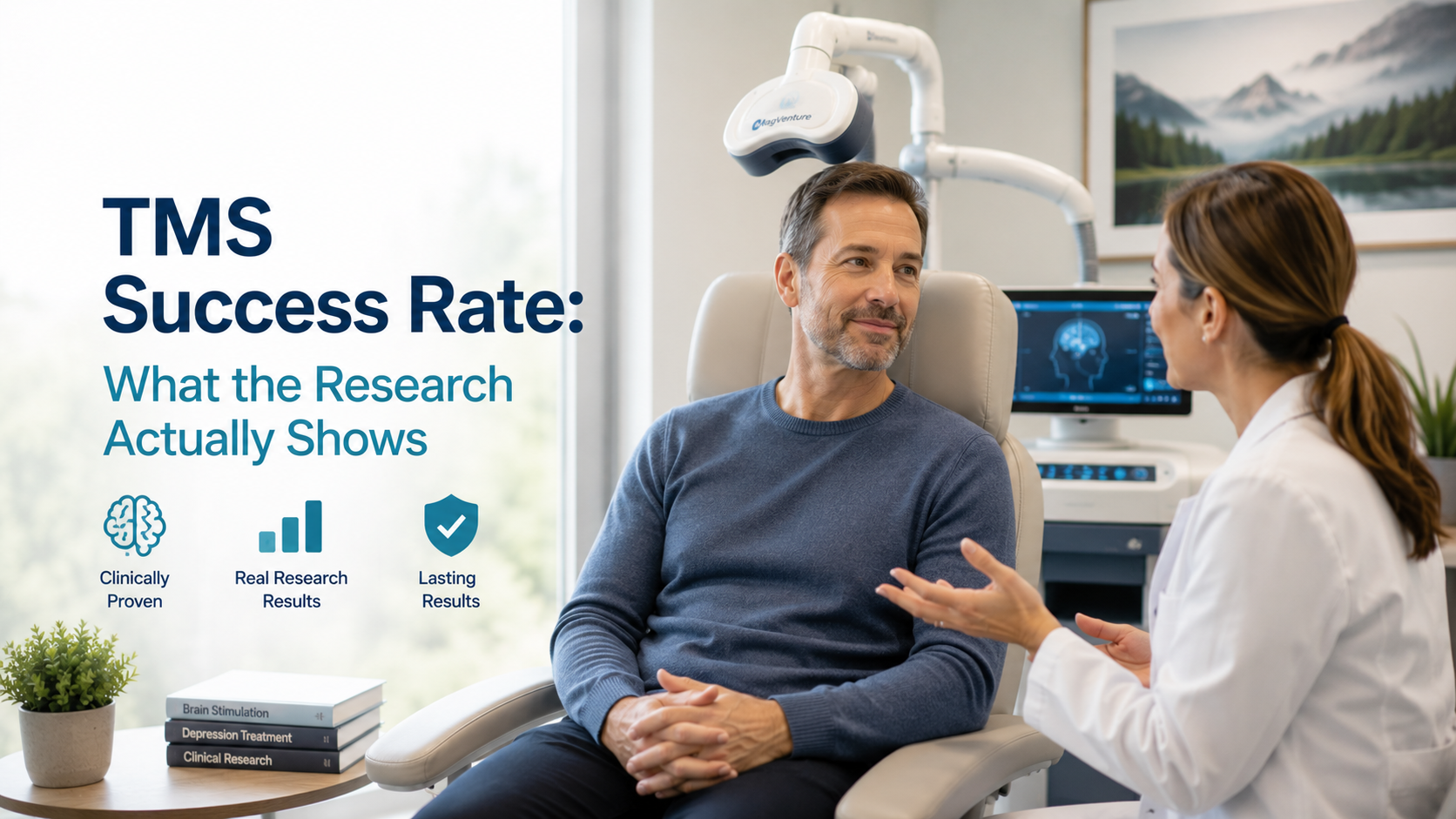

If you are weighing whether to try transcranial magnetic stimulation (TMS), the first question is almost always the same: does it actually work? The honest answer is that TMS works for a meaningful share of people who have not improved on medication — but the headline numbers you see online range wildly, from a modest 30% to an eye-catching 90%, and that range is exactly where most articles mislead you.
Here is what the research actually shows. For depression, standard TMS produces a response in roughly 50–60% of patients and full remission in about 30–40%. Newer accelerated protocols report higher figures in clinical trials, while real-world registries land somewhere in between. The reason the numbers jump around so much is that “success” is measured in different ways, in different patients, using different protocols. Once you understand those distinctions, the data becomes far more useful for making a decision.
What “Success” Actually Means in TMS
Before comparing any percentages, you have to know what is being counted. Three terms do most of the work in the research, and they are not interchangeable:
- Response means a clinically significant improvement — usually defined as at least a 50% reduction in depression symptoms on a standardized rating scale. A person who responds feels substantially better but may still have some symptoms.
- Remission is the higher bar: symptoms drop low enough that the person no longer meets the criteria for depression. This is the outcome most patients are actually hoping for.
- Relapse tracks the other direction — the percentage of people whose symptoms return after a period of improvement. It is the key measure of how durable the benefit is.
When a clinic advertises a “75% success rate,” it is almost always quoting a response rate, not remission. Neither number is wrong, but they describe very different results. Throughout this article we separate the two so you can compare like with like.
TMS Success Rate for Depression: What the Studies Show
Depression is where TMS has the deepest evidence base, and it is the condition the FDA first cleared TMS to treat back in 2008. Crucially, most of these studies enroll people with treatment-resistant depression — patients who have already failed one or more antidepressants. That matters, because this is a harder-to-treat group, and the success rates below are achieved after other options have fallen short.
Success also depends heavily on which version of TMS you receive. The three protocols below differ in how they target the brain and how many pulses they deliver, and those differences show up in the outcomes.
Standard rTMS Success Rate
Repetitive TMS (rTMS) is the original and still most common protocol: daily sessions, five days a week, over four to six weeks. Across decades of research, roughly 50–60% of patients respond and 30–40% reach remission. Harvard Health and Yale Medicine both cite figures in this range, and a 2023 UCLA Health analysis of 708 patients found a 54% response rate when outcomes were tracked carefully with multiple rating scales.
For the most treatment-resistant patients — those who have failed several medications — the numbers are lower but still meaningful: around 30% respond and roughly 19% reach remission. That is far from a guarantee, but for someone who has exhausted other options, a one-in-three chance of meaningful relief from a non-drug, non-invasive treatment is significant.
One detail the UCLA work highlights is the value of measurement-based care: when clinicians use only a single rating scale, they can miss up to a third of genuine responses. In other words, how a practice measures your progress affects what your reported success rate even is.
Deep TMS Success Rate
Deep TMS (dTMS), delivered with an H-coil (the technology behind BrainsWay systems), reaches broader and deeper brain regions than standard figure-8 coils. Manufacturer-sponsored trials have reported higher numbers — in some completer analyses, response rates of around 75–82% and remission near 58–65% after a full course. It is worth reading those figures with care: intent-to-treat results (which count everyone who started, including dropouts) tend to be lower than completer results, so the “real” rate for a typical patient usually sits below the most optimistic headline.
If you are comparing devices, our breakdown of NeuroStar vs. BrainsWay Deep TMS explains how the two approaches differ and why the marketing numbers are not always comparable.
Accelerated TMS & SAINT Success Rate
The most striking recent numbers come from accelerated protocols, especially Stanford’s SAINT/SNT approach, which uses fMRI-guided targeting and delivers about 50 sessions over just five days. In a double-blind randomized trial, roughly 79% of patients reached remission and around 86% responded — figures Stanford summarized as “nearly 80% effective.” One month after treatment, about 60% were still in remission.
Those results are genuinely promising, but two caveats keep them honest: the trials are smaller than the decades of rTMS research, and long-term durability data is still limited. Accelerated TMS compresses a six-week commitment into one to two weeks, which is a major practical advantage — but the high remission rates should be read as early, encouraging evidence rather than a settled long-term guarantee.
TMS Success Rate for OCD
The FDA cleared Deep TMS for obsessive-compulsive disorder in 2018, making it one of the few non-medication, non-surgical options for OCD that has not responded to standard care. The pivotal multicenter trial reported a response rate of about 38% at six weeks (versus roughly 11% with sham treatment), with response defined as a meaningful reduction in symptoms on the Yale-Brown Obsessive Compulsive Scale (Y-BOCS). Other studies put symptom reductions in the 30% range.
OCD success rates are lower than depression rates, and that is expected — OCD is notoriously hard to treat. But for patients who have not gotten relief from SSRIs and exposure therapy, those odds can still be worth pursuing. If OCD is your primary concern, see how we approach OCD treatment and the different types of OCD that respond differently to treatment.
TMS Success Rate for Anxiety
Anxiety is more nuanced. TMS is not separately FDA-cleared for generalized anxiety disorder on its own, but it is cleared for “anxious depression” — depression that occurs alongside significant anxiety — and the data there is encouraging. Studies of patients with anxious depression show that TMS reduces both depressive and anxiety symptoms, with response patterns broadly similar to depression alone.
Because so many people experience depression and anxiety together, this matters in practice. We cover the specifics in our guide to TMS therapy for anxiety and how it compares to medication in TMS vs. medications for anxiety. If your anxiety occurs without depression, TMS may still be considered, but the evidence is less established — an honest conversation with a psychiatrist is the right next step.
How Long Does TMS Last? Durability and Relapse
A high response rate means little if the benefit disappears in a month. So how durable is TMS? The realistic picture: many people stay well for months to years, but relapse is common enough that maintenance planning matters. Research suggests roughly half of people who recover with rTMS experience some return of symptoms within 12 months — though many of those respond well to a repeat course or periodic “booster” sessions.
This is one area where TMS compares favorably to faster-acting treatments. Its benefits tend to outlast those of ketamine, for example, which often fades within days to weeks of stopping. We dig into the durability question — and what maintenance actually looks like — in the long-term benefits of TMS therapy. The takeaway: TMS is best thought of not as a one-time cure, but as a treatment that can produce lasting relief, sometimes supported by occasional follow-up sessions.
What Affects Your TMS Success Rate
Population averages only tell you so much. Several factors shift the odds for any individual patient, and a few of them are within your control:
- How early you try it. Patients who turn to TMS after one or two failed medications tend to do better than those who try it only after many failures. Earlier is generally better.
- The protocol used. As the sections above show, deep and accelerated protocols report higher numbers than basic rTMS — though with trade-offs in cost and evidence maturity.
- Targeting precision. Even a few millimeters of difference in coil placement can affect results. fMRI-guided and carefully measured targeting outperform rough manual methods.
- Completing the full course. TMS works cumulatively. Stopping early — a common reason real-world results lag clinical trials — lowers your odds. Adherence to the daily schedule genuinely matters.
- Measurement-based care. Practices that track your symptoms weekly can catch what is working, adjust early, and detect improvement that a single snapshot would miss.
- Combining treatments. Pairing TMS with therapy or continued medication can improve and sustain results for some patients.
Not sure whether you are a strong candidate? Our guide to the 5 signs TMS therapy may help your depression is a useful starting point, and debunking common TMS myths clears up the misconceptions that scare people away from an effective option.
How TMS Compares to Other Depression Treatments
Success rates only mean something in context. Here is how TMS stacks up against the main alternatives for depression that is not improving:
- Antidepressant medication. First-line antidepressants work well for many, but their returns drop sharply with each failed trial. Large studies suggest that after several medications have failed, the remission rate from yet another drug falls to roughly 35% or lower — which is precisely why TMS becomes a logical next step rather than a fifth pill.
- Ketamine and esketamine. These act fast, often within hours, but the benefit can fade quickly without ongoing treatment. TMS tends to be slower to work but more durable. For some patients, esketamine (Spravato) is the better fit; for others, TMS is. They are not mutually exclusive.
- Electroconvulsive therapy (ECT). ECT has some of the highest remission rates of any depression treatment, but with a heavier side-effect profile, including memory effects and anesthesia. TMS is far gentler. Our full TMS vs. ECT comparison breaks down when each makes sense.
One of TMS’s biggest advantages is tolerability. Compared with medication and ECT, its side effects are usually mild and short-lived — most often scalp discomfort or headache that eases after the first few sessions.
Is TMS Worth It?
For the right patient, the math is compelling: a non-invasive, drug-free treatment with mild side effects that helps a majority of people who had run out of options. In patient surveys, around three-quarters of people who completed TMS said it was helpful, and most said they would choose it again.
That said, TMS is not for everyone. It is not typically a first move before any medication has been tried, it requires a real time commitment, and — like every depression treatment — it does not work for everyone. The most honest framing is this: if you have tried two or more antidepressants without enough relief, the evidence strongly supports at least exploring TMS. The cost question is often less daunting than people expect, too; see how much TMS costs in Maryland and whether insurance covers TMS, since most major plans now do.
TMS at Bright Horizons Psychiatry in Rockville, Maryland
At Bright Horizons Psychiatry in Rockville, MD, we treat the kind of complex, treatment-resistant depression where TMS tends to do its best work. Just as important, we practice measurement-based care — tracking your symptoms throughout treatment so we can tell early whether it is working and adjust when it is not. As the research makes clear, that approach is part of what separates a strong success rate from a disappointing one.
Whether TMS is right for you depends on your history, your diagnosis, and your goals — none of which a percentage on a webpage can answer. The next step is a real evaluation with a psychiatrist who can tell you, candidly, what your odds look like.
See if TMS is right for you
Bright Horizons Psychiatry offers Deep TMS and advanced depression care in Rockville and Frederick, Maryland. Book a consultation and we will give you an honest read on whether TMS fits your situation.
Frequently Asked Questions
What is the average success rate of TMS?
For depression, standard TMS produces a response (at least 50% symptom improvement) in about 50–60% of patients and full remission in roughly 30–40%. Accelerated and deep protocols report higher figures in clinical trials. The exact number depends on the protocol, the patient’s treatment history, and how outcomes are measured.
Is TMS safe?
TMS is FDA-cleared and considered very safe. It is non-invasive, requires no anesthesia or sedation, and the most common side effects are mild and temporary — typically scalp tenderness or a headache during the first sessions. The main serious risk, seizure, is extremely rare. See our guide to TMS side effects for details.
What does TMS do to the brain?
TMS uses focused magnetic pulses to stimulate nerve cells in mood-regulating regions of the brain, particularly the dorsolateral prefrontal cortex, which is often underactive in depression. Repeated sessions are thought to “rewire” or normalize activity in these circuits, which is why the benefit builds over a course of treatment rather than appearing instantly.
Does TMS work for anxiety and OCD?
TMS is FDA-cleared for OCD and for depression with co-occurring anxiety (anxious depression). For OCD, response rates are around 38% in pivotal trials — lower than for depression, but meaningful for a hard-to-treat condition. For anxiety occurring alongside depression, TMS reduces both sets of symptoms.
How long does TMS last, and what if it stops working?
Many people stay well for months or years, though about half experience some return of symptoms within a year. The good news is that repeat courses and periodic maintenance sessions tend to work well, so a relapse is not the end of the road. Learn more about the long-term benefits of TMS.
Medical disclaimer: This article is for general educational purposes and is not medical advice. Success rates are population averages drawn from published research and may not reflect individual results. Always consult a qualified psychiatrist about your specific situation before making treatment decisions.
Key sources: UCLA Health (Leuchter et al., Psychiatry Research, 2023); Harvard Health; Yale Medicine; Stanford Medicine (SAINT/SNT trial, American Journal of Psychiatry, 2021); BrainsWay Deep TMS pivotal trials; Carmi et al. (OCD, 2019); STAR*D antidepressant data; Clinical TMS Society.