
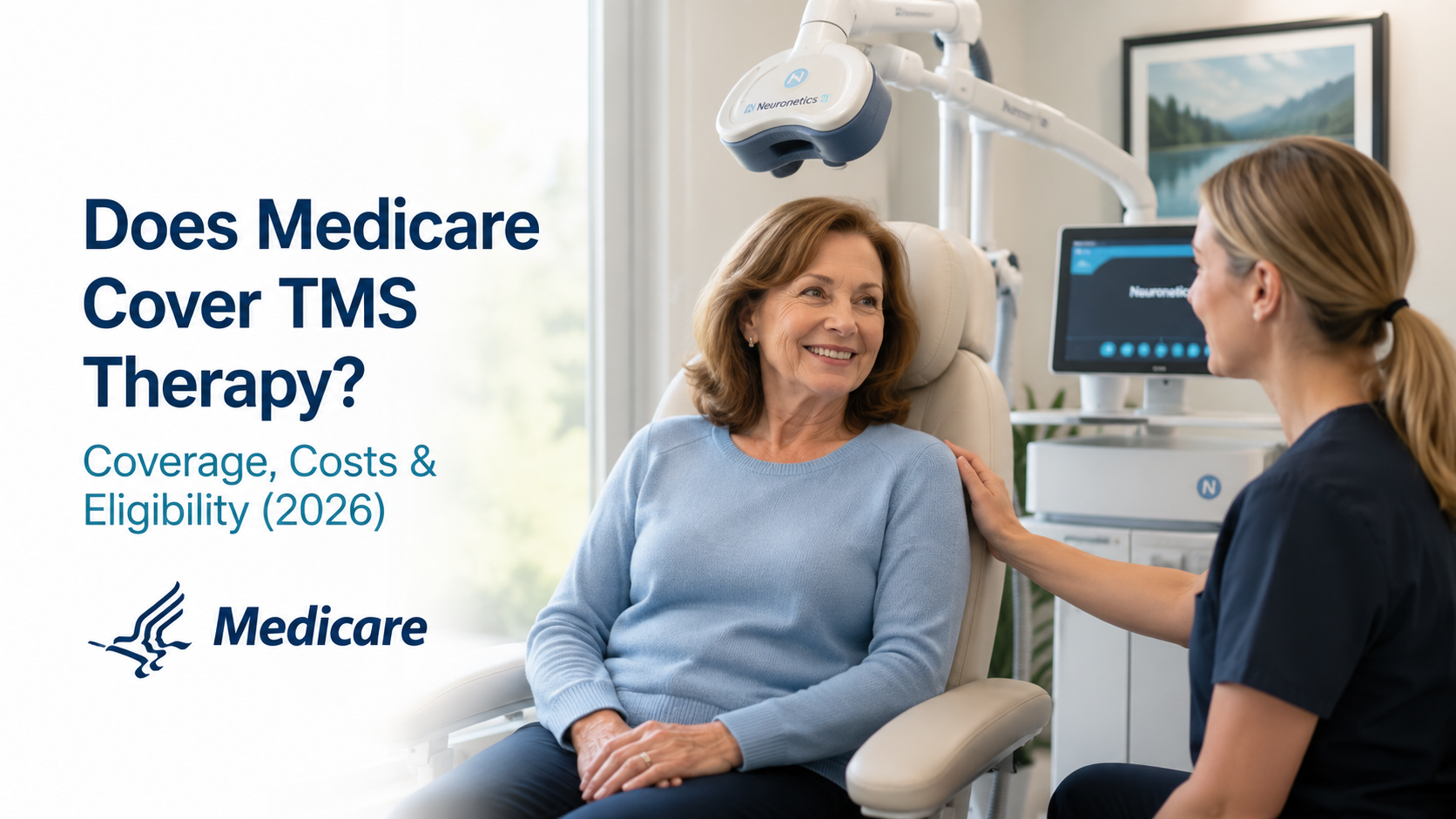

Does Medicare cover TMS therapy?
Yes. Medicare Part B covers TMS therapy (transcranial magnetic stimulation) for adults diagnosed with severe major depressive disorder (MDD) when it is medically necessary and standard treatments have failed. Coverage is limited to depression — Medicare does not pay for TMS used to treat other conditions — and you must meet specific clinical criteria set out in Medicare’s coverage rules before treatment is approved.
If you have Original Medicare, TMS is treated like other outpatient care: after you meet your Part B deductible, Medicare pays 80% of the approved amount and you are responsible for the remaining 20% (unless a Medigap or other secondary plan covers it). Below, we break down exactly who qualifies, how many sessions are covered, what you can expect to pay in 2026, and the situations where Medicare will not cover TMS.
Quick summary
- Covered for: severe major depressive disorder (MDD) only
- Medicare part: Part B (outpatient); also covered by Medicare Advantage / Part C
- Sessions: daily outpatient treatment for up to roughly 6 weeks (about 36 sessions)
- Your cost: 20% coinsurance after the Part B deductible ($283 in 2026)
- Prior authorization: not required by Original Medicare; may be required by Medicare Advantage
Who qualifies for Medicare-covered TMS?
Medicare follows clinical criteria laid out by its regional contractors in documents called Local Coverage Determinations (LCDs). In Maryland — and across the rest of Jurisdiction L (Washington D.C., Delaware, New Jersey, and Pennsylvania) — the contractor is Novitas Solutions, whose LCD governs when TMS is considered medically necessary. To qualify, you generally must meet all of the following:
- A confirmed diagnosis of severe major depressive disorder (single or recurrent episode), based on the criteria in the current Diagnostic and Statistical Manual of Mental Disorders (DSM-5-TR).
- A documented history of failed medication treatment — typically a lack of meaningful improvement after trials of antidepressants from at least two different drug classes in the current episode, an inability to tolerate those medications, or a prior positive response to TMS in an earlier episode.
- An order from a psychiatrist (MD or DO) who has performed an in-person examination and reviewed your records before recommending treatment.
This is the same population Deep TMS therapy is designed for: people whose treatment-resistant depression hasn’t responded adequately to medication. If you’ve tried two or more antidepressants without relief, you may already meet Medicare’s failed-medication requirement.
How many TMS sessions does Medicare cover?
Medicare covers daily outpatient TMS therapy for up to approximately six weeks. In practice, a standard course is about 36 sessions — typically five sessions per week for six weeks, sometimes followed by a brief taper. Coverage is tied to medical necessity, so your psychiatrist documents your progress throughout the course.
Newer accelerated protocols, including SAINT (Stanford Accelerated Intelligent Neuromodulation Therapy), compress treatment into a shorter window. Medicare continues to recognize these approaches under specific billing codes where they are medically necessary, though availability and documentation requirements can vary by provider and region. The procedure codes most often used for TMS are 90867 (initial treatment with motor-threshold mapping), 90868 (each subsequent session), and 90869 (re-mapping when needed).
How much does TMS cost with Medicare in 2026?
Under Original Medicare, TMS is billed through Part B. That means your out-of-pocket cost depends on your deductible and the standard 20% coinsurance — not a flat per-session fee. Here are the 2026 figures:
Cost component (2026)
Amount
What it means for TMS
Part B monthly premium
$202.90 (standard)
Ongoing premium you pay to keep Part B; higher earners pay more
Part B annual deductible
$283
You pay this once per year before Medicare starts paying its share
Coinsurance
20%
After the deductible, Medicare pays 80% of the approved amount and you pay 20%
With Medigap (supplement)
Often $0–minimal
Many Medigap plans cover the 20% coinsurance, reducing your cost to little or nothing
Because TMS runs for several weeks, the 20% coinsurance can add up across roughly 36 sessions — which is exactly why a Medigap plan or Medicare Advantage benefits structure matters. The good news: patients who meet the criteria rarely pay anything close to the full cash price of TMS, which can run several thousand dollars without insurance.
Which part of Medicare pays for TMS — Part B, Advantage, or Medigap?
Part B (Original Medicare) is the primary payer for outpatient TMS. Medicare Advantage (Part C) plans are required to cover at least everything Original Medicare covers, so TMS is included — but copays, networks, and prior-authorization rules are set by the private insurer, so they differ plan to plan. Medigap (Medicare Supplement) plans don’t replace Part B; they sit alongside it and typically pick up the 20% coinsurance and sometimes the deductible, which can bring your TMS cost down to nearly zero.
Does Medicare require prior authorization for TMS?
Original Medicare (Parts A and B) generally does not require prior authorization for TMS — your psychiatrist documents medical necessity, and claims are reviewed against the LCD criteria. Medicare Advantage plans, however, frequently do require prior authorization. If you’re on an Advantage plan, ask your provider’s office to confirm the authorization is approved before your first session so you aren’t surprised by a denial. Our team handles this verification for patients as part of insurance eligibility checks.
When Medicare does not cover TMS
Even with a depression diagnosis, Medicare will not cover TMS in certain situations. Coverage is typically excluded when a patient has:
- An implanted magnetic-sensitive or metal device near the head — such as a cochlear implant, deep brain stimulator, aneurysm clip, pacemaker, or cardiac defibrillator
- A seizure disorder or a history of seizures
- Acute or chronic psychotic symptoms during the current depressive episode
- Certain neurological conditions, including dementia, a history of significant head trauma, or central nervous system tumors
These are safety-based contraindications, not arbitrary rules — the strong magnetic fields used in TMS can interfere with implanted devices or raise seizure risk in vulnerable patients. A thorough psychiatric evaluation screens for all of these before treatment begins.
Does Medicare cover TMS for OCD, anxiety, or PTSD?
This is one of the most common points of confusion. TMS is FDA-cleared and clinically used for several conditions beyond depression, including OCD. Medicare, however, currently covers TMS only for severe major depressive disorder. If TMS is recommended for OCD, generalized anxiety, or PTSD on its own, Medicare typically classifies that use as investigational and will not pay for it. Many patients who don’t qualify for Medicare-covered TMS explore alternatives such as Spravato (esketamine), which is covered for treatment-resistant depression under different criteria.
How to verify your Medicare TMS coverage
Coverage rules are consistent in their broad strokes but the details — especially deductibles met, Advantage plan requirements, and documentation — are personal to you. The most reliable path:
- Get a psychiatric evaluation to confirm a severe MDD diagnosis and document your medication history.
- Have your provider’s billing team verify benefits against your specific plan, including any Advantage prior-authorization step.
- Ask about your secondary coverage (Medigap or another plan) to estimate your real out-of-pocket cost.
Bright Horizons Psychiatry is a Medicare-accepting psychiatry practice in Rockville, Maryland, offering Deep TMS for adults with treatment-resistant depression. Our team verifies your Medicare benefits up front and handles the documentation, so you know what’s covered before you start. Learn more about our approach to depression treatment or contact us to check your eligibility.
Frequently asked questions
Is TMS covered by Medicare?
Yes. Medicare Part B covers TMS therapy for adults with severe major depressive disorder who meet medical-necessity criteria, including failed medication trials and a psychiatrist’s order following an in-person exam.
How many TMS treatments does Medicare cover?
Medicare covers daily outpatient TMS for up to about six weeks, which usually works out to around 36 sessions for a standard course.
How much does TMS cost with Medicare?
After your 2026 Part B deductible of $283, you pay 20% coinsurance of the Medicare-approved amount. A Medigap supplement often covers that 20%, reducing your cost to little or nothing.
Does Medicare Advantage cover TMS?
Yes. Medicare Advantage (Part C) plans must cover at least what Original Medicare covers, so TMS is included for severe MDD — but copays and prior-authorization rules vary by plan.
Does Medicare cover TMS for anxiety or OCD?
No. Medicare currently covers TMS only for severe major depressive disorder. Use of TMS for OCD, anxiety, or PTSD on its own is generally considered investigational and not covered.
Does Medicare require prior authorization for TMS?
Original Medicare does not require prior authorization for TMS. Medicare Advantage plans often do, so confirm approval with your plan before starting treatment.
Disclaimer: This article is for general educational purposes and reflects Medicare coverage rules as of June 2026. Coverage criteria, costs, and Local Coverage Determinations can change and vary by plan and region. It is not medical or insurance advice. Verify your specific benefits with your provider and Medicare before beginning treatment.
Sources: CMS Medicare Coverage Database, LCD L34998 (Novitas, TMS in the Treatment of Adults with MDD); CMS 2026 Medicare Parts A & B Premiums and Deductibles fact sheet; Medicare.gov.