


Mental health in Frederick MD services split into two routes. In a crisis, call or text 988, or walk into the free crisis center at 340 Montevue Lane, open 24 hours a day. For ongoing psychiatric care, start with your insurer, call several practices on the same day, and know that state-regulated Maryland plans must meet a 10 calendar day standard for non-urgent mental health appointments.
Finding a psychiatrist in Frederick has become harder, not easier. On August 1, 2025, the Frederick County Health Department closed its outpatient Mental Health Services clinic. Its phone line now helps former patients with records and points callers to community providers, their insurance company and 2-1-1. People who relied on that clinic, and people looking for care for the first time, are now working through the same private practices, hospital programs and nonprofit services.
This guide to mental health in Frederick MD shows how to find a psychiatrist in seven steps, from deciding what kind of help you need to judging whether the first appointment went well. It covers crisis options, insurance rules most people never hear about, realistic wait times and what to bring. Where we mention our own Frederick office we say so plainly, and we also say who we are not the right fit for.
Why Getting Help for Mental Health in Frederick MD Takes a Plan
Psychiatrists are scarce across the United States, and recent research shows how scarce. In a 2023 mystery shopper study published in General Hospital Psychiatry, researchers called 948 outpatient psychiatrists in five states as prospective new patients. Only 18.5 percent were available to see a new patient. The median wait was 67 days for an in-person appointment and 43 days for telepsychiatry, and the most common reason for no appointment was that the psychiatrist was not taking new patients.
Medicaid enrollees face a steeper climb. A 2024 study in JAMA checked psychiatrists listed as in network for Medicaid in New York City, Los Angeles, Chicago and Phoenix. Fewer than 18 percent could be reached, accepted Medicaid and offered a new patient appointment. Some listings had wrong phone numbers, and many calls went unanswered on two separate attempts.
Neither study measured Frederick, and no public source reports local wait times, so treat these numbers as a warning rather than a forecast. The practical lesson holds anyway. Directories overstate availability, one phone call is rarely enough, and the people who get seen quickly tend to be the ones who call several offices, ask direct questions and use the rules their insurance plan already has to follow.
Step 1, Decide What Kind of Help You Need
Before you search, get clear on what you are looking for. The right first call is different for a crisis, for therapy, for a diagnosis and for medication that is not working.
If This Is a Crisis, Skip the Search
A psychiatrist’s office is not the right place for an emergency. If you or someone with you is in immediate danger, call 911. For a crisis that is not a medical emergency, the fastest routes to support for mental health in Frederick MD cost nothing.
- Call or text 988. The 988 Suicide and Crisis Lifeline is available any time by phone, text or chat.
- Call 301-662-2255. This is the 24 hour crisis line of the Mental Health Association of Frederick County. The same line reaches the county’s mobile crisis team, which meets people at home or in the community at no cost.
- Walk in to 340 Montevue Lane, Frederick, MD 21702. The walk-in crisis center is open 24 hours a day, seven days a week, is free and open to all, and lists urgent psychiatric medication evaluation among its services. Anyone under 16 needs a guardian with them.
- Go to the emergency department at Frederick Health Hospital, 400 West 7th Street. Its behavioral health team provides crisis evaluation by licensed mental health professionals and admission to inpatient care when needed.

Psychiatrist, Nurse Practitioner, Therapist or Primary Care
Psychiatrists are medical doctors who diagnose mental health conditions and prescribe and manage medication. Psychiatric mental health nurse practitioners, often shortened to PMHNPs, also evaluate, diagnose and prescribe, and at many practices, including ours, they work under a psychiatrist’s clinical guidance. Therapists, such as psychologists and licensed clinical social workers, provide talk therapy but do not prescribe.
Which one you need depends on the problem. If you want weekly therapy for stress, grief or relationship strain, a therapist is usually the right first call. If you have tried medication without enough relief, need a diagnosis such as adult ADHD confirmed, or have depression that has not responded to treatment, a psychiatric evaluation is the better starting point. Our guide on whether psychiatrists do therapy explains the split in more detail.
Primary care can be a real option for milder symptoms. Maryland Medicaid, for example, states that primary care providers may evaluate and treat mild depression or anxiety within their scope of practice. Many primary care doctors manage uncomplicated cases and refer to psychiatry when treatment is not working.
Match the Level of Care to the Situation
Outpatient care, meaning scheduled office or video visits, fits most people. When symptoms are more intense but a hospital stay is not needed, a partial hospitalization or intensive outpatient program offers several hours of structured treatment a day. In Frederick, Frederick Health runs a psychiatric partial hospital program and intensive outpatient program, plus a 21 bed inpatient behavioral health unit for acute symptoms. Our explainer on outpatient mental health services covers how to tell which level fits.
Step 2, Start With Your Insurance Plan
Insurance shapes how fast you get seen more than almost anything else, so spend ten minutes on the phone with your plan before you call a single practice. Have your member ID card in hand and call the member services or behavioral health number on the back.
Commercial Insurance and Maryland’s Appointment Rules
Ask member services for a list of in-network psychiatrists and psychiatric nurse practitioners near Frederick who are accepting new adult patients. Ask whether your plan requires a referral from your primary care doctor, since some HMO plans do. Write down the name of the person you spoke with and the date of the call.
Most people never hear about the next part. Maryland regulation COMAR 31.10.44.06 sets appointment waiting time standards for insurance carriers. Non-urgent mental health care has a standard of 10 calendar days, and urgent mental health care has a standard of 72 hours. Carriers must meet these standards for at least 90 percent of appointments.
If your plan cannot offer an in-network specialist without an unreasonable wait or unreasonable travel, the Maryland Insurance Administration explains that you can ask the plan to approve an out-of-network specialist. When that approval covers mental health care, the plan applies your in-network cost sharing, and a rule in effect since January 1, 2023 bars the out-of-network mental health specialist from billing you beyond that amount. Plans usually have to decide within two working days of receiving the information they need.
One caveat matters. These protections apply to plans regulated by the state of Maryland. Many large employers fund their own health plans, and those self-funded plans follow federal rules instead. If you are not sure which kind you have, ask member services directly whether your plan is regulated by the Maryland Insurance Administration.
Medicare
Medicare Part B covers outpatient mental health care, including psychiatric evaluation and medication management, from psychiatrists and nurse practitioners who accept Medicare. After the Part B deductible, you generally pay 20 percent of the Medicare-approved amount. If you have a Medicare Advantage plan, use that plan’s own directory and member services line, because networks vary from plan to plan.
Maryland Medicaid
Maryland Medicaid handles mental health differently from physical health. Specialty behavioral health services are carved out of HealthChoice managed care, and all members work with Carelon Behavioral Health of Maryland to reach those services. Carelon’s main number is 1-800-888-1965. The HealthChoice Help Line, 800-284-4510, can help with questions about your plan.
Because of that carve out, your managed care plan’s directory may not be the right place to look for a psychiatrist. Ask Carelon for providers near Frederick who accept Maryland Medicaid and are taking new patients, then call each one yourself to confirm. Our separate guide to Medicaid accepting psychiatrists in Maryland has more detail.
Paying Out of Pocket
If you have no insurance, or you want a psychiatrist who is out of network, ask each practice for its self-pay rate for a first evaluation and for follow-ups, since the two are usually priced differently. Ask whether the practice provides a superbill, the itemized receipt you can submit to your insurer for possible out-of-network reimbursement. Community programs, including the Sheppard Pratt Outpatient Mental Health Center at 210 Abrecht Place in Frederick, are worth a call to ask about cost and eligibility.
Step 3, Build a Short List From the Right Sources
Aim for five to eight names, not one. Several sources list providers for mental health in Frederick MD, and each has a weakness worth knowing.
- Your insurer’s directory. It is the best starting point for cost, but the Medicaid study above shows that listed does not mean available. Treat every listing as unconfirmed until you call.
- 2-1-1 Maryland. Dial 2-1-1 for information and referrals to local health and human services in more than 150 languages. The county health department now directs former clinic patients to 2-1-1 as well.
- The Mental Health Association of Frederick County. FCMHA publishes a Guide to Mental Health and Community Support Resources that lists licensed mental health professionals, psychiatric facilities and more than 300 community support services.
- Your primary care doctor. A referral from someone who knows your history can help a new practice understand your needs before the first visit.
- Professional and commercial directories. The American Psychiatric Association’s Find a Psychiatrist tool and directories such as Psychology Today let you search by location. Profiles are self-reported, so confirm insurance and new patient status by phone.
- Hospital and community programs. Frederick Health’s behavioral health line is 240-566-3900, and Sheppard Pratt’s Frederick outpatient center can be reached at 301-663-8263.

Step 4, Ask the Right Questions When You Call
The first phone call is where most time gets lost. A few direct questions tell you within minutes whether a practice can actually help.
- Are you accepting new adult patients right now?
- Do you take my exact plan? Give the plan name printed on your card, not just the insurance company, because a practice can be in network for one product and not another.
- When is the first available new patient appointment, and with which clinician?
- Is the first visit in person or by video?
- Do you treat my condition? Name it specifically, such as adult ADHD, OCD or depression that has not responded to treatment.
- Do you provide therapy, medication management or both?
- Do you keep a cancellation list?
- What will the first visit cost me after insurance?
If a practice cannot see you for months, ask whether its staff can suggest another office that might. Front desk teams sometimes know which local practices have openings, and the question costs nothing.
Step 5, Plan Around Realistic Wait Times
Waits vary by practice, clinician type, insurance and whether you can do video visits. The national data above suggests that a first in-person appointment with a psychiatrist can take weeks or months, while telepsychiatry tends to be faster. You can shorten your own wait in several practical ways.
- Call several practices on the same morning rather than one a week.
- Be open to a psychiatric nurse practitioner for your evaluation and ongoing care.
- Ask to be placed on every cancellation list, and answer unknown numbers for a few days afterward.
- Ask whether follow-ups can be done by video, which makes ongoing care easier to fit around work and family.
- Ask your primary care doctor to keep managing your current medication while you wait, so you are not left without care.
- If your plan cannot produce an in-network appointment within the state standard, call member services, cite the 10 calendar day standard and ask for help, including an out-of-network referral if needed.
For reference, our Frederick office currently reports that most new patients are seen within 3 to 5 business days. Availability changes, so confirm the current wait when you call any practice, including ours.
Step 6, Know What to Bring to Your First Appointment
A first psychiatric evaluation runs longer than a routine doctor’s visit, and the more organized information you bring, the more of that time goes to you rather than to paperwork. At our practice, new patient evaluations take about an hour and can run longer for complex histories.
- A photo ID and the front and back of your insurance card.
- A current medication list with names, doses and how often you take each one, including over-the-counter products, vitamins and supplements.
- A history of past mental health medications, including roughly how long you took each one, the highest dose you reached and why you stopped. This matters most if your depression has not responded to treatment.
- Completed intake forms. Many practices, including ours, send these electronically after scheduling.
- Prior psychiatric records, recent lab work and contact details for past providers, if you have them.
- A short written list of your symptoms, when they started and the questions you want answered.
- Your family mental health history, as far as you know it.
- A way to pay your copay or deductible.

Many practices welcome a trusted family member or friend at the first visit, so ask ahead of time if you would like company. The National Institute of Mental Health also publishes practical tips for talking with a health care provider about your mental health.
Do not expect every first visit to end with a prescription. A careful evaluation sometimes ends with lab work or a request for past records first. Our comprehensive psychiatric evaluation guide walks through what happens before, during and after that first appointment.
Step 7, Judge the Fit After the First Visit
A good first evaluation should leave you with a clearer picture, even if not every answer. These are signs of a solid start.
- The clinician asked about your history, medical conditions, sleep, substance use and daily functioning, not only your current symptoms.
- You heard a working diagnosis, or a clear explanation of what still needs to be ruled out.
- Treatment options were explained along with their tradeoffs, and your preferences shaped the plan.
- You know when your follow-up is, how to reach the office between visits and what to do if things get worse.
If the fit feels wrong, it is reasonable to ask for a different clinician in the same practice or to keep looking. Your records can follow you to a new practice once you sign a release.
Where Bright Horizons Psychiatry Fits in Frederick
We are one of several outpatient options for mental health in Frederick MD. Our practice has offices in Rockville and Frederick, and both see adults only. The Frederick office opened in August 2026 at 7360 Guilford Drive, Suite 100, Frederick, MD 21704. It is open Monday through Friday from 9 a.m. to 6 p.m., and the phone number is (240) 599-1001.
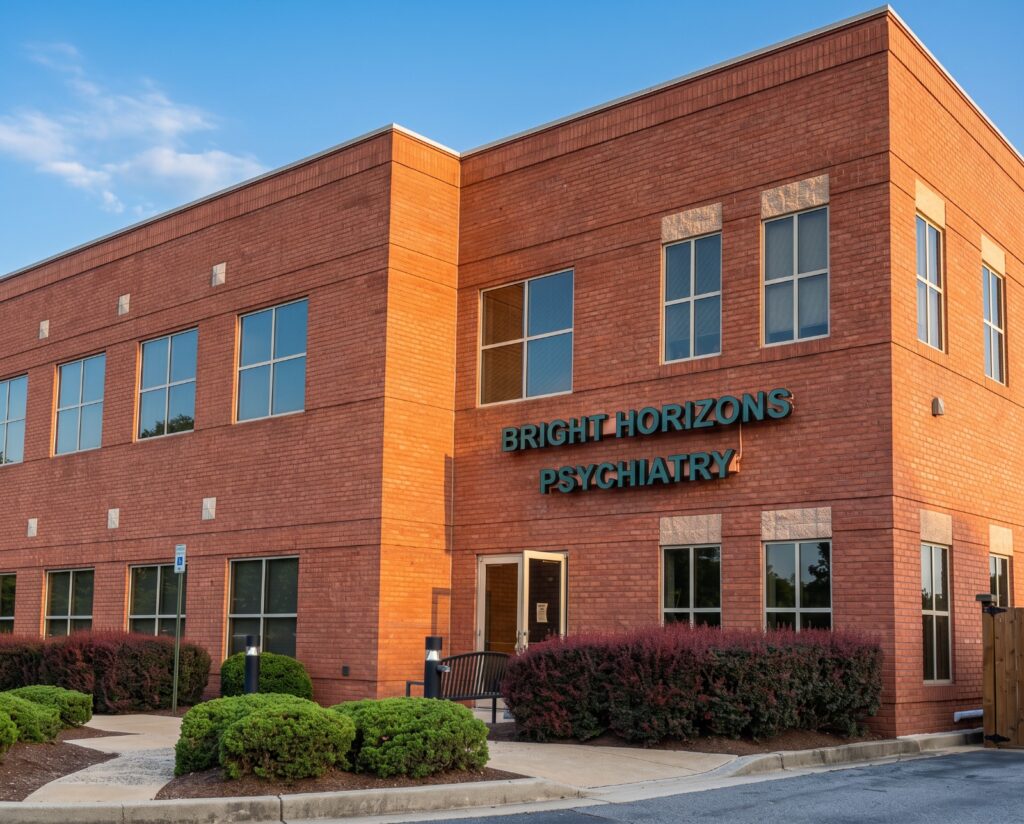
In Frederick we provide psychiatric evaluation and medication management for depression, including depression that has not responded to treatment, as well as anxiety, OCD and adult ADHD. Adult ADHD evaluations are completed by our nurse practitioners under a psychiatrist’s guidance and include a clinical interview, rating scales and testing. We also offer Spravato treatment in Frederick with on-site monitoring, and intramuscular ketamine. Deep TMS is offered only at our Rockville office.
The first visit is in person. After that, most follow-ups can happen by secure video from anywhere in Maryland. We accept Medicare, Maryland Medicaid, Aetna, Blue Cross Blue Shield, Cigna, UnitedHealthcare, Tricare and Johns Hopkins EHP, and we verify your benefits on the first phone call. You do not need a referral to book with us, although your own plan may require one for coverage.
We are not the right fit for everyone. We do not treat bipolar disorder (bipolar I or II), psychosis, substance use disorders or personality disorders, and we do not see children or teens. When someone calls us with one of those needs, we point them toward specialty programs such as Sheppard Pratt or Johns Hopkins, and the crisis options above remain available at any hour. If you are an adult looking for a psychiatrist in Frederick, MD for one of the conditions we treat, our location page has the full details.
Frequently Asked Questions
How long does it take to see a psychiatrist in Frederick, MD?
It depends on the practice, your insurance and whether you accept video visits. National research found a median wait of 67 days for an in-person psychiatry appointment and 43 days for telepsychiatry. State-regulated Maryland plans must meet a 10 calendar day standard for non-urgent mental health appointments, so call your plan if you cannot find one. Our Frederick office reports that most new patients are seen within 3 to 5 business days.
Do I need a referral to see a psychiatrist in Maryland?
Many practices, including ours, do not require one. Some HMO plans do require a referral from your primary care doctor before they will cover specialist visits, so check your plan before the first appointment.
Where can I get free help for mental health in Frederick MD?
The Mental Health Association of Frederick County runs a 24 hour crisis line at 301-662-2255, a mobile crisis team and a free walk-in crisis center at 340 Montevue Lane that is open around the clock. You can also call or text 988, or dial 2-1-1 for referrals to local services.
Does Maryland Medicaid cover psychiatrists in Frederick?
Yes. Specialty mental health services for Maryland Medicaid members are managed through Carelon Behavioral Health of Maryland, reachable at 1-800-888-1965, separately from your HealthChoice plan. Confirm directly with each practice that it accepts Maryland Medicaid and is taking new patients.
What happened to the Frederick County Health Department mental health clinic?
The county’s outpatient Mental Health Services clinic closed on August 1, 2025. Its line, 301-600-1755, helps former patients with medical records and refers callers to community providers, their insurance plan and 2-1-1.
Can I see a psychiatrist in Frederick by telehealth?
Many practices offer video visits. At our practice the first evaluation is in person at our Rockville or Frederick office, and most follow-ups can then happen by secure video from anywhere in Maryland.
What should I bring to my first psychiatrist appointment?
Bring a photo ID, your insurance card, a list of current medications with doses, a history of past mental health medications, completed intake forms, any prior records or recent lab work, and a short list of your symptoms and questions.