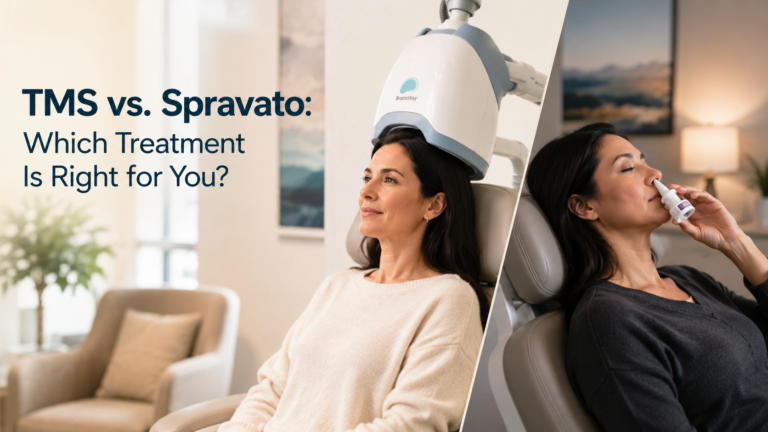


Ketamine therapy in Maryland comes in four forms. Spravato nasal spray is FDA approved for treatment-resistant depression and is covered by most insurance plans with prior authorization. IV infusions and IM injections are off-label, usually paid in cash, and typically cost $300 to $500 or more per session. At-home programs also exist, but the FDA has warned about unmonitored use.
At Bright Horizons Psychiatry we offer two of those four options, Spravato and intramuscular (IM) ketamine, at both of our offices. Our Rockville office is at 6000 Executive Blvd, Suite 101, and our Frederick office is at 7360 Guilford Dr, Suite 100. IM ketamine starts at $349 a session and is cash pay. Spravato is billed to insurance, and our team submits the prior authorization for you. We do not offer IV infusions or at-home ketamine. You can reach both offices at (240) 599-1001.
This guide answers the seven questions people ask most about ketamine therapy in Maryland before they commit to treatment, from whether ketamine is legal here to what a first month really costs and which plans pay for it. Where we describe our own practice we say so plainly, and we are just as clear about who ketamine therapy is not right for.
1. What Is Ketamine Therapy, and Is It FDA Approved?
Ketamine was created in 1962 as an anesthetic and approved by the FDA for anesthesia in 1970, according to the National Institute of Mental Health. It is still approved as an intravenous or intramuscular injection for anesthesia. It is not FDA approved for depression or any other psychiatric condition, which means clinics that use it for mood symptoms are prescribing it off-label. Off-label prescribing is legal and common in medicine when a physician judges that the evidence supports it, but it also explains why most insurers will not pay for it.
Ketamine works differently from standard antidepressants. Most antidepressants act on serotonin and related chemical messengers and need four to six weeks to show whether they are working. Ketamine blocks a receptor for glutamate, the brain’s most common excitatory messenger, and researchers believe this sets off a rapid burst of new connections between nerve cells. In NIMH research, intravenous ketamine lifted depression within hours in some patients, and about half of people who receive it find meaningful relief.
Spravato is the one ketamine-based treatment with full FDA approval for depression. It contains esketamine, one of the two mirror-image halves of the ketamine molecule, delivered as a nasal spray. The FDA approved it in 2019 for treatment-resistant depression, added depressive symptoms in adults with major depression and suicidal thoughts in 2020, and in January 2025 approved it as a standalone treatment for treatment-resistant depression. Every dose must be given in a certified clinic, followed by at least two hours of monitoring.
The strongest recent evidence for plain ketamine comes from a 2023 trial in the New England Journal of Medicine. Researchers randomly assigned 403 adults with treatment-resistant depression without psychosis to IV ketamine twice a week or to electroconvulsive therapy three times a week for three weeks. Response rates were 55.4 percent with ketamine and 41.2 percent with ECT, and ketamine met the study’s test for being at least as effective. Most ketamine research uses IV infusions. IM injection delivers the same medication by a different route, and its research base is smaller.
2. Is Ketamine Therapy Legal in Maryland?
Yes. Ketamine therapy in Maryland is legal when a licensed clinician prescribes or administers it. Ketamine has been a Schedule III controlled substance under federal law since 1999, and it also appears on Maryland’s own Schedule III list in the state’s Criminal Law Article, section 5-404. Schedule III means it has accepted medical uses along with a real potential for misuse. Possessing it without a valid prescription is a crime in Maryland, and the prescribing clinician must hold both a federal DEA registration and a Maryland controlled dangerous substances registration.
Legal is not the same as FDA approved for depression, and it is not the same as safe in every setting. That distinction matters most for at-home ketamine. Telehealth programs now ship compounded ketamine lozenges to Maryland addresses after a video evaluation. These programs work by prescription, but the products are not FDA approved for any psychiatric use, and each dose is taken without a clinician in the room.
The FDA warning issued on October 10, 2023 addressed this directly. The agency said the lack of monitoring for side effects by an onsite health care provider may put patients at risk, and it listed sedation, dissociation, rises in blood pressure, slowed breathing, bladder and urinary symptoms, misuse, and worsening psychiatric symptoms. For that reason, every dose at our practice, whether Spravato or IM ketamine, is given in the office with a clinician present.
3. Which Kind of Ketamine Therapy Fits Your Situation?
The four forms of ketamine therapy in Maryland differ on approval status, who pays, and how closely you are watched. This table summarizes the practical differences before we look at each one.
| Option | FDA status for depression | Where it is given | How it is usually paid | Monitoring |
|---|---|---|---|---|
| Spravato nasal spray | Approved for treatment-resistant depression | Certified clinic only | Insurance, usually with prior authorization | At least 2 hours on site |
| IV ketamine infusion | Off-label | Infusion clinic | Mostly cash | Clinician present through infusion and recovery |
| IM ketamine injection | Off-label | Medical office | Mostly cash | Clinician present through session and recovery |
| At-home tablets or lozenges | Off-label, compounded | Your home | Cash, often a subscription | No clinician on site |
Spravato Nasal Spray
Spravato is usually the first option to check if you have insurance and have already tried at least two antidepressants without enough relief. It is the only form most plans cover, so it is often the least expensive route for insured patients. You give yourself the spray under supervision, then rest in the office for at least two hours. Our Spravato treatment page covers the full schedule and what each visit involves.
IV Ketamine Infusion
IV ketamine is the form used in most of the research, delivered as a slow drip into a vein. It allows the dose to be adjusted during the infusion. It is almost always cash pay, and a typical first series is six infusions over two to three weeks. We do not offer IV infusions at our practice.
IM Ketamine Injection
IM ketamine uses the same medication as IV ketamine, given as an injection into a muscle. There is no IV line, the visit is simpler, and the cost per session is usually lower than an infusion. The trade off is a smaller body of research than IV. IM ketamine suits patients who do not qualify for Spravato, whose plan will not cover Spravato, or who do not want to wait on a prior authorization.
At-Home Ketamine
At-home programs are convenient, but they remove the on-site monitoring that the FDA flagged as a safety issue. If you are weighing any two of these options, our side by side comparison of Spravato, IV ketamine and IM ketamine goes deeper on effectiveness, side effects and the patient experience.
4. How Much Does Ketamine Therapy Cost in Maryland?
The cost of ketamine therapy in Maryland depends mostly on the form of treatment and whether your insurer is involved. Cash prices for off-label ketamine are published by some clinics and hidden by others, so here is what we could verify in September 2026.
- IM ketamine at our offices. Sessions start at $349. Most patients have one or two sessions a week, about 6 to 8 in the first month, which comes to roughly $2,094 to $2,792 at the starting price. Maintenance sessions after that are typically every two to four weeks. The first consultation is billed to insurance when your plan covers it.
- IV ketamine at other Maryland clinics. One Annapolis clinic publishes an average of $450 to $500 per infusion, with six infusions over two to three weeks and a total that can reach $4,500 including consultation and follow up. Another Maryland ketamine clinic puts the statewide range at $300 to $1,300 per session, depending on the type of treatment and coverage.
- Spravato. With insurance, what you pay depends on your deductible, copay and coinsurance. Commercially insured patients may qualify for the manufacturer’s savings program, which generally excludes Medicare, Medicaid and TRICARE. Our breakdown of what Spravato costs with and without insurance walks through the numbers.
Ask any clinic offering ketamine therapy in Maryland about the costs that do not appear on a price list. Every in-office session needs a driver, and most people lose at least half a day of work. Some clinics sell packages up front, so ask what happens to the money if you stop early because treatment is not helping or side effects are too much. Finally, ask what maintenance costs, because the first month is rarely the last.
5. Does Insurance Cover Ketamine Therapy in Maryland?
Insurance coverage for ketamine therapy in Maryland splits cleanly along FDA approval. Spravato is covered by most plans when you meet their criteria. IV and IM ketamine for depression are usually not covered, because the use is off-label.
Plans That Cover Spravato
- Commercial plans. Most major plans cover Spravato for adults with treatment-resistant depression, typically defined as not enough response to at least two antidepressants. Nearly all require prior authorization.
- Medicare. Medicare and many Medicare Advantage plans cover Spravato when the coverage criteria are met.
- Maryland Medicaid. Spravato is listed on the Maryland Medicaid mental health formulary, updated September 2026. Ketamine is not listed.
- TRICARE. The TRICARE East medical policy covers Spravato for adults who meet its criteria, with preauthorization required and dosing only at a certified facility.
Why IV and IM Ketamine Are Usually Cash Pay
Off-label ketamine therapy in Maryland is generally cash pay. The same TRICARE East policy states that ketamine administered in any form is not covered for the treatment of depression. A few Maryland clinics report that certain commercial plans pay toward IV ketamine, so if a clinic says it can bill your insurer for ketamine sessions, ask for a written estimate before your first visit.
Some parts of care are still usually billable even when ketamine sessions are not. At our practice, the initial consultation and psychiatric evaluation are billed to insurance when your plan covers them, and follow-up medication management works the same way. For plan by plan details on Spravato, see our Maryland guide to Spravato insurance coverage. We accept Medicare, Maryland Medicaid, Aetna, Blue Cross Blue Shield, Cigna, UnitedHealthcare, TRICARE and Johns Hopkins EHP.
6. Who Is a Good Candidate for Ketamine Therapy?
Ketamine therapy is not a first step. It is meant for adults whose depression has not responded well enough to standard care, and a careful evaluation matters more than the choice of route. You are more likely to be a good candidate if one or more of the following applies to you.
- You have treatment-resistant depression, meaning at least two antidepressants at an adequate dose and duration have not brought enough relief.
- You have depression with significant anxiety alongside it.
- You have depression tied to trauma or PTSD that has not responded to therapy or medication.
- Your symptoms are severe enough that waiting several more weeks on another antidepressant trial carries a real cost.

Clinics offering ketamine therapy in Maryland generally screen for the same risks. Ketamine is usually not appropriate, or needs extra caution, in these situations.
- Active substance use disorder, especially involving dissociative or hallucinogenic drugs
- Uncontrolled high blood pressure, because ketamine temporarily raises it
- A history of psychosis or current psychotic symptoms
- Pregnancy or breastfeeding
- Severe liver disease or certain heart conditions, which your clinician screens for
Bring a complete list of your medications to the evaluation. Some sedating anti-anxiety medicines may blunt the response to ketamine, and some stimulants can add to its temporary rise in blood pressure. Your prescriber decides whether anything should change, so never stop a medication on your own before a session.
Our practice treats adults 18 and older for depression, along with anxiety, OCD and ADHD. We do not treat bipolar disorder (bipolar I or II), psychosis, substance use disorders or personality disorders, and we refer people with those needs to specialty programs. Ketamine therapy is not an emergency treatment. If you are thinking about suicide or are in crisis, call or text 988 now, or call 911.
7. How Do You Choose a Ketamine Clinic in Maryland?
Clinics offering ketamine therapy in Maryland are concentrated around Baltimore, Columbia, Annapolis and Montgomery County, and they range from psychiatric practices to anesthesia-led infusion centers to wellness centers. The questions below separate careful programs from convenient ones.
- Who evaluates you, and is your psychiatric diagnosis confirmed before the first dose?
- Who is medically responsible during the session, and what is monitored, such as blood pressure and alertness?
- Is the full price in writing, including the evaluation, each session and maintenance?
- What happens if the first series does not help? A good clinic has a plan B, not just a longer package.
- Will the clinic coordinate with your current psychiatrist, prescriber or therapist?
- How far away is it? Spravato starts at two visits a week for four weeks, and IM ketamine often means 6 to 8 visits in the first month, each one with a driver.
Be cautious with any clinic that promises a specific success rate for you, skips a psychiatric evaluation, or pushes a large prepaid package at the first visit. Distance deserves more weight than most people give it. A clinic 20 minutes away that you can reach twice a week will usually serve you better than a slightly cheaper one an hour away.
Ketamine Therapy at Our Rockville and Frederick Offices
If you are comparing options for ketamine therapy in Maryland, here is how it works with us. Both Spravato and IM ketamine are available at our Rockville office and our Frederick office. Dr. Amir Etesam, a board-certified psychiatrist trained at Johns Hopkins, leads both services and focuses his own practice on treatment-resistant depression. IM ketamine sessions are supervised by Dr. Etesam and administered by licensed members of our clinical team, and Spravato sessions are staffed by psychiatric nurse practitioners trained in its administration.
What an IM Ketamine Session Looks Like
- Before. Do not eat for two hours or drink for 30 minutes before your session. Arrange a ride home, because you cannot drive afterward, and wear comfortable clothes.
- During. Plan on one to two hours in a private room. A clinician gives the injection and monitors you, including your blood pressure. Feeling relaxed, detached, dreamy or light-headed is common and temporary.
- After. You go home with your driver once you are stable and alert. Take it easy for the rest of the day and hold off on work or major decisions. Most patients feel like themselves by the next morning.
What a Spravato Course Looks Like
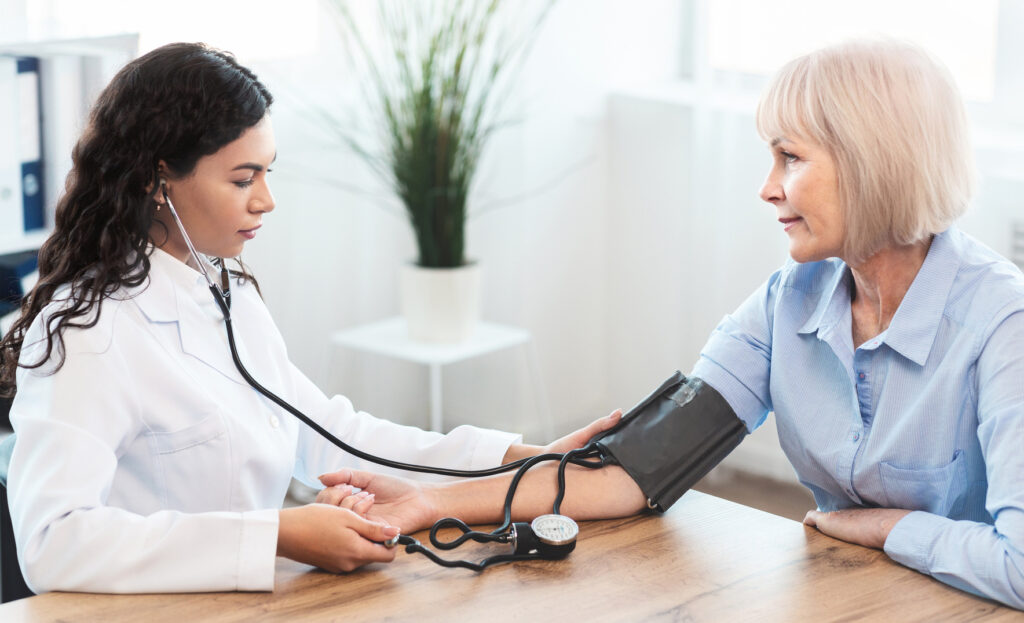
Spravato follows a set schedule. Weeks one to four include two sessions a week, weeks five to eight include one session a week, and from week nine sessions happen every week or every other week depending on your response. Each visit includes at least two hours of monitoring. You should not drive or operate machinery until the next day after a restful sleep, so you will need a ride after every session.
Side Effects to Expect
The most common effects of ketamine therapy are dissociation or a floating feeling, dizziness, nausea, sleepiness, blurred vision and a temporary rise in blood pressure. In an NIMH analysis of five clinical trials, most side effects after a single IV dose peaked within an hour and were gone within two hours, and none lasted more than four hours. That short window is why monitoring focuses on the first hours after a dose.
If ketamine or Spravato is not the right fit, it is not the only option for depression that has not responded to medication. Deep TMS is FDA cleared for depression and is available at our Rockville office only. After your first in-person evaluation, most medication follow-ups can happen by secure video from anywhere in Maryland, although every ketamine and Spravato dose is given in the office.
Frequently Asked Questions
Is ketamine therapy legal in Maryland?
Yes, when a licensed clinician prescribes or administers it. Ketamine is a Schedule III controlled substance under both federal law and Maryland’s Criminal Law Article, section 5-404. Possessing it without a valid prescription is illegal.
How much does ketamine therapy cost in Maryland?
It depends on the form. IM ketamine at our Rockville and Frederick offices starts at $349 per session, or roughly $2,094 to $2,792 for a typical first month of 6 to 8 sessions. One Annapolis clinic publishes about $450 to $500 per IV infusion, and up to $4,500 for a first series. Spravato is usually billed to insurance.
Does insurance cover ketamine therapy in Maryland?
Insurance usually covers Spravato, the FDA approved nasal spray, with prior authorization. IV and IM ketamine for depression are off-label and are usually cash pay, although the evaluation and follow-up visits are often billable.
Does TRICARE cover ketamine therapy?
TRICARE covers Spravato for adults who meet its criteria, with preauthorization. Under the TRICARE East medical policy, ketamine administered in any form is not covered for the treatment of depression.
Does Maryland Medicaid cover ketamine therapy?
Spravato is listed on the Maryland Medicaid mental health formulary. Ketamine itself is not listed, so IV and IM ketamine for depression are generally not covered. Our practice accepts Maryland Medicaid.
Is at-home ketamine therapy in Maryland safe?
Telehealth programs ship compounded ketamine lozenges to Maryland addresses after a video evaluation. They work by prescription, but the FDA has warned that taking it without an onsite clinician may put patients at risk. Every dose at our practice is given in the office with monitoring.
Can I drive after a ketamine or Spravato session?
No. You need a ride home after every session. After Spravato, you should not drive until the next day following a restful sleep.
Where can I get IM ketamine or Spravato near Rockville or Frederick?
Bright Horizons Psychiatry offers both at 6000 Executive Blvd, Suite 101, Rockville, MD 20852 and at 7360 Guilford Dr, Suite 100, Frederick, MD 21704. Call (240) 599-1001 to schedule an evaluation.