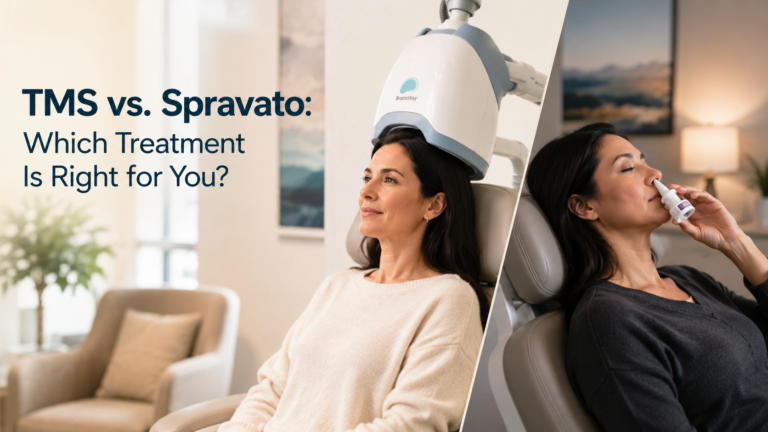


If your psychiatrist has mentioned ketamine therapy for depression, you have probably encountered three different versions of the same general idea. Spravato, which is a nasal spray. Intravenous ketamine, which is a slow drip into a vein. Intramuscular ketamine, which is an injection into a muscle. They all work through similar mechanisms in the brain, but they are not interchangeable, and the choice between them shapes everything from cost to insurance coverage to the actual experience of treatment.
Spravato vs ketamine is the question most patients arrive with, and the honest answer is more nuanced than most clinic websites suggest. Most clinics only offer one of the three options, which means most online comparisons are written by people whose answer is shaped by what they sell. The actual clinical picture is that each form has genuine strengths and real trade-offs, and the right choice depends on the patient’s situation, insurance, schedule, and preferences.
This guide explains how Spravato, IV ketamine, and IM ketamine actually differ, where the evidence stands on which is most effective, and how to think through the decision if your psychiatrist has offered more than one as an option. By the end you should be able to have a real conversation with your prescriber about which form fits your situation best.
The Three Forms Are Chemically Related but Not Identical
All three treatments work on the same general principle. They modulate the brain’s NMDA receptor and trigger increased glutamate signaling, which appears to promote rapid neuroplasticity in patients with depression. The relief many patients experience within hours or days, rather than the weeks typical of standard antidepressants, comes from this mechanism.
Spravato Is Esketamine, the S-Isomer
Ketamine as a molecule is technically a mixture of two mirror-image versions, called R-ketamine and S-ketamine. Spravato (esketamine) is the purified S-version only, formulated as a nasal spray and FDA-approved in 2019 for treatment-resistant depression and later for major depressive disorder with acute suicidal ideation.
The S-isomer binds more selectively to the NMDA receptor, which is part of why it can be delivered effectively as a nasal spray. The FDA approval also means Spravato is the only one of the three forms with formal indication for depression, full clinical trial data, and standardized dosing.
IV Ketamine Is Racemic Ketamine, Off-Label
Intravenous ketamine uses racemic ketamine, the original mixture of both R and S isomers, delivered as a slow infusion into a vein over about 40 minutes. Ketamine itself has been FDA-approved as an anesthetic since the 1970s, but its use for depression remains off-label, which means individual physicians prescribe it based on clinical judgment rather than a formal FDA indication for depression.
The off-label status does not mean unproven. There is substantial clinical research on IV ketamine for depression, and major academic psychiatry programs have used it for treatment-resistant cases for over a decade. The off-label status mainly affects insurance coverage and standardization across clinics.
IM Ketamine Is Also Racemic Ketamine, Just Delivered Differently
Intramuscular ketamine is the same racemic ketamine as IV ketamine, but injected into a muscle (typically the deltoid or thigh) rather than infused into a vein. The medication enters the bloodstream more quickly than oral or nasal forms, but the patient experience and clinical effect are similar to IV ketamine, just with a simpler delivery method that does not require an IV line, infusion pump, or extended infusion time.
IM ketamine is also off-label for depression. The clinical evidence base is somewhat smaller than for IV ketamine, but practitioners who use it report similar patterns of response.
How They Actually Differ in Practice
Beyond the chemistry, the three forms differ in ways that matter to patients trying to decide between them.
The Treatment Experience
Spravato is self-administered as a nasal spray under direct observation. Patients sit comfortably, spray the medication into each nostril at intervals, and then settle in for a two-hour observation period. There are no needles, no IVs, and no infusion pumps. Patients who are uncomfortable with venous access often prefer this format for that reason alone.
IV ketamine involves placing an IV line in the arm and running a slow infusion over approximately 40 minutes, followed by another period of observation. The total clinic time is similar to Spravato, but the experience involves a needle in the arm for the duration of infusion. Some patients find the IV experience more clinical and less calming.
IM ketamine involves a single injection into a muscle, similar to a vaccine but with a different medication and a longer post-injection observation period. The injection itself takes seconds, and the medication takes effect within several minutes. The total observation time is shorter than Spravato or IV, but the onset of dissociation can feel faster and more intense for some patients.
FDA Approval and Regulatory Framework
Spravato is FDA-approved for treatment-resistant depression and major depressive disorder with acute suicidal thinking. It is delivered through the FDA-required REMS (Risk Evaluation and Mitigation Strategy) program, which means certified clinics, monitored administration, and structured patient enrollment. More on that framework is in our Spravato REMS guide.
IV and IM ketamine for depression are off-label, which means there is no FDA-required safety program governing their delivery. Quality clinics still follow rigorous protocols for screening, dosing, monitoring, and follow-up, but the consistency across clinics varies more than with Spravato. Patients researching IV or IM ketamine clinics should ask specifically about screening protocols, dosing standards, and post-treatment monitoring.
Insurance Coverage and Cost
This is where the three forms diverge most significantly for most patients.
Spravato is covered by most commercial insurance plans, Medicare Part B, and Maryland Medicaid for FDA-cleared indications. Prior authorization is required, but once approved, out-of-pocket costs are typically modest. The Janssen Observation Rebate Program can further reduce out-of-pocket observation costs to zero for eligible commercially insured patients.
IV ketamine for depression is rarely covered by insurance because it is off-label. Most clinics charge between 400 and 650 dollars per session out of pocket, and a typical induction course is six sessions over two to three weeks. Total cost for the initial course often runs 2,500 to 4,000 dollars, with maintenance treatments adding to that over time.
IM ketamine is similarly off-label. Per-session costs are usually lower than IV (often 200 to 400 dollars depending on the clinic), partly because the delivery is simpler and requires less infrastructure. It is also generally not covered by insurance.
Treatment Schedule
Spravato follows a standardized FDA protocol. Twice a week for the first four weeks, weekly during the second month, and every one to two weeks for maintenance after that. The protocol does not vary much between patients.
IV ketamine protocols vary more between clinics. A typical induction course is six sessions over two to three weeks, followed by a flexible maintenance schedule based on individual response. Some patients return for boosters every few weeks, others every few months.
IM ketamine often follows a similar induction-then-maintenance pattern as IV. The flexibility makes it easier to adjust to individual response patterns.
What the Evidence Says About Effectiveness
The honest answer is that the comparative evidence on Spravato vs ketamine is mixed and still evolving.
Recent comparative studies suggest IV ketamine and Spravato are roughly equivalent for treatment-resistant depression, with both producing meaningful response rates in patients who have not responded to standard antidepressants. Some studies have found IV ketamine slightly more effective; others have found the two roughly equal. Some research has noted that IV ketamine is associated with higher rates of certain side effects (dissociation, blood pressure changes, sedation) than Spravato, which uses a more selective formulation.
For IM ketamine, the comparative evidence is thinner. Practitioners who use IM report response patterns similar to IV, but the formal clinical trial base is smaller.
What this means in practical terms is that for most patients with treatment-resistant depression, all three forms are reasonable options that can produce meaningful improvement. The choice between them is rarely about which one will work best clinically. It is about which one fits the patient’s situation in terms of cost, insurance, schedule, and personal preference.
How to Decide Which Form Fits Your Situation
The decision tree below covers the most common factors that shape the choice between Spravato, IV ketamine, and IM ketamine.
If Insurance Coverage Matters
Spravato is the only one of the three covered by most insurance plans. For patients without significant out-of-pocket flexibility, Spravato is usually the right starting point. The combination of insurance coverage, the Janssen rebate program for observation costs, and Medicare and Maryland Medicaid acceptance makes Spravato accessible to patients across a wide range of financial situations.
If Speed of Response Matters Most
IV and IM ketamine often produce rapid antidepressant response within a single session for some patients, although this is not universal. Spravato also works rapidly compared to standard antidepressants but typically over the course of several sessions rather than after a single dose. For patients in acute crisis where speed is a critical factor, IV or IM ketamine may have a slight edge, although Spravato is also FDA-approved for major depressive disorder with acute suicidal thinking, which suggests it works rapidly enough for serious situations.
If You Are Uncomfortable With Needles
Spravato avoids needles entirely. For patients with significant needle phobia or vein access difficulties, this can be a meaningful factor. IM ketamine uses a single brief injection rather than a sustained IV line, which is sometimes more tolerable than a 40-minute infusion for needle-averse patients.
If You Have Tried Spravato and It Did Not Work
Some patients who do not respond fully to Spravato find better response with racemic IV or IM ketamine. The R-isomer present in racemic ketamine but not in Spravato may contribute to antidepressant effect through pathways that the S-isomer alone does not fully activate. The reverse is also occasionally true, with patients who did not tolerate IV ketamine doing better on Spravato.
If You Want the Most Standardized Protocol
Spravato has the most standardized treatment protocol, the clearest evidence base, the most consistent dosing across clinics, and the most regulatory oversight through REMS. For patients who value structure, predictability, and the comfort of an FDA-approved framework, Spravato is the cleanest choice.
If Cost Flexibility Is Limited and Insurance Will Not Cover IV or IM
For most patients, this rules out IV and IM ketamine as a starting point and pushes the decision toward Spravato. The exception is patients who have specifically tried Spravato without success and are willing to pay out of pocket for racemic ketamine in either IV or IM form.
Where Each Form Fits Best
A simplified summary that captures the typical fit for each form.
Spravato is the right starting point for most patients with treatment-resistant depression who have insurance coverage, want an FDA-approved option, and prefer a non-injection format. The standardized protocol, insurance coverage, and REMS oversight make it the most accessible advanced ketamine-based treatment for most adults.
IV ketamine is the right fit for patients who can pay out of pocket, who want the option of racemic ketamine (both R and S isomers), and who are working with a clinician who has substantial IV ketamine experience. It can also be an option for patients who tried Spravato without success.
IM ketamine is the right fit for patients who want a faster delivery method than IV but the same racemic formulation, who can pay out of pocket, and who are comfortable with the injection format. It can also be a more accessible option than IV in clinics that offer both, since the simpler delivery often translates to lower per-session cost.
Treatment Options at Bright Horizons Psychiatry
Our practice in Rockville offers Spravato and intramuscular ketamine. We do not currently offer IV ketamine, which means patients who specifically need the IV format are referred to clinics that specialize in it. We are honest about this limitation rather than steering every patient toward what we offer.
Spravato Treatment
We are a REMS-certified outpatient setting for Spravato, which means we provide the medication, the trained staff, the monitoring infrastructure, and the two-hour observation environment required by the program. The treatment rooms are designed to be calm and unrushed. Full details are on our Spravato page.
Intramuscular Ketamine
For patients whose treatment plan includes IM ketamine, the procedure is delivered in our clinic under medical supervision with appropriate monitoring. IM ketamine is typically self-pay rather than insurance-covered. More information is on our intramuscular ketamine page.
Choosing the Right Option for You
The decision between Spravato and IM ketamine at our practice is made during the psychiatric evaluation, based on the patient’s diagnosis, prior treatment history, insurance situation, and personal preferences. For most adults with treatment-resistant depression who have insurance, Spravato is the starting recommendation. For patients who have tried Spravato without sufficient response, IM ketamine can be considered as a next step within our practice, or referral to an IV ketamine clinic if the racemic IV format is clinically indicated.
Questions to Ask Your Prescriber
If your psychiatrist has offered more than one ketamine-based option, several questions help clarify the decision.
Ask about insurance coverage for each option, including any prior authorization requirements and the typical out-of-pocket cost. Ask about the clinic’s experience with each form, including how many patients they have treated and what their response rates look like. Ask about the screening criteria the clinic uses to determine who is a good candidate for each form. Ask about the protocol for managing side effects during and after treatment. Ask what happens if the first form does not produce sufficient response, including whether the clinic can switch to a different form within the same practice or whether referral elsewhere is needed.
For background on ketamine and esketamine as antidepressant treatments, the National Institute of Mental Health has published useful overviews of the science.
Frequently Asked Questions
Is Spravato the same as ketamine?
Not exactly. Spravato is esketamine, which is one of the two mirror-image versions of ketamine. Standard ketamine (used in IV and IM forms) is racemic, meaning it contains both the S-version (esketamine) and the R-version (arketamine). Spravato is the purified S-version only. Both work on similar brain mechanisms but with slightly different binding profiles.
Which is more effective, Spravato or IV ketamine?
The comparative evidence is mixed. Recent studies suggest the two are roughly equivalent for treatment-resistant depression, with some research showing slight advantages for IV ketamine and other research showing equivalence. For most patients, both produce meaningful response. The right choice usually comes down to factors other than raw efficacy, including insurance coverage, format preference, and individual response.
Why is Spravato covered by insurance but IV and IM ketamine are not?
Spravato is FDA-approved for treatment-resistant depression, which means insurance plans recognize it as a covered medication for that indication. IV and IM ketamine for depression are off-label uses of an older medication, and insurance plans generally do not cover off-label psychiatric uses of ketamine. The off-label status does not mean the treatments are unproven, but it does mean patients pay out of pocket.
Can I switch between forms if one is not working?
Yes, in many cases. Some patients who do not fully respond to Spravato find improvement with IV or IM ketamine, possibly because of the R-isomer present in racemic ketamine. The reverse is also sometimes true. Switching is a clinical decision made with your prescriber based on response patterns and treatment history.
What are the main side effects of Spravato vs ketamine?
All three forms can cause dissociation (feeling disconnected from yourself or surroundings), drowsiness, blood pressure changes, dizziness, and nausea. The side effects typically peak within the first 30 to 90 minutes after administration and resolve within two hours. Some research suggests IV ketamine has higher rates of dissociation and blood pressure changes than Spravato, while Spravato may have higher rates of nausea due to the nasal route.
How long does each form take from start to finish?
Spravato treatments take about 2.5 to 3 hours total per visit (administration plus 2 hours of observation). IV ketamine typically takes 1.5 to 2 hours total (40-minute infusion plus observation). IM ketamine takes about 1 to 1.5 hours total (a brief injection plus shorter observation). Schedules vary by clinic and individual response.
Can these treatments be done at home?
No. Spravato cannot be dispensed for home use under REMS rules. IV and IM ketamine must be administered under medical supervision in a clinic setting because of the risk of dissociation, blood pressure changes, and the need for monitoring during onset. Telehealth-based oral or sublingual ketamine is offered by some platforms, but the safety and efficacy of unsupervised home ketamine for depression remain an active area of regulatory and clinical concern.